DeFi Hack News: 2026 Crypto Hacks Report

DeFi hack news in 2026 was led by two April exploits, KelpDAO and Drift, but the year’s biggest crypto hacks hit an exchange.
DefiLlama counts $8.74 billion stolen in the crypto hacks 2026 has seen from January 1 to October 31, across 327 incidents, and about $6.36 billion of it left Binance on October 29 in roughly 20 minutes. US agencies blame North Korea-linked hackers for that theft. Nearly $2.7 billion of the Binance haul was frozen within hours, yet about $2.4 billion in ETH and BTC is still beyond any issuer’s reach.
Article contents
- 1 DeFi Hack News in 2026
- 2 What the 2026 Totals Can Say Right Now
- 3 Biggest Crypto Hacks of 2026
- 4 Crypto Exchange Hacks in 2026
- 5 North Korea-Linked Crypto Hacks
- 6 How the 2026 Hacks Happened
- 7 What These Figures Do Not Decide
- 8 Frequently Asked Questions
- 8.1 Which Months Does This 2026 Crypto Hacks Report Cover?
- 8.2 What Is Counted as a Crypto Hack in the 2026 Totals?
- 8.3 Do 2026 Hack Rankings Count Funds That Were Later Returned?
- 8.4 Can a Public Blockchain Freeze Coins Stolen in a 2026 Hack?
- 8.5 What Should You Do First If Your Own Crypto Was Stolen in One of These Incidents?
- 8.6 Does a DeFi Protocol Hack Drain Every Wallet That Interacted With It?
- 9 Conclusion
DeFi Hack News in 2026
In 2026 attackers hit lending markets, perpetuals venues, restaking bridges, and old token contracts. DefiLlama tags 234 of the 327 incidents as DeFi protocols, worth $1.19 billion, while four centralized exchanges lost $6.78 billion. April looked huge because of two DeFi attacks worth about $577 million, while October was almost all one exchange.
What Counts as a DeFi Hack
A DeFi hack is a confirmed exploit or theft that moved protocol or pooled funds without permission. KelpDAO and Drift both qualify, because the attackers took assets users had deposited into shared contracts.
A token price crash, a rumor, one person’s lost seed phrase, and a rug pull by a project’s own team are not hacks and stay out of the totals. DefiLlama keeps neighbouring categories apart from the DeFi hacks 2026 produced: 25 blockchain-level incidents worth $435 million, such as the Liquid sidechain, and 12 wallet incidents worth $238 million, such as Coldcard. Drift counts once, whether a story quotes $285 million or $295 million.
The Largest DeFi Exploits So Far
On April 18, attackers drained 116,500 rsETH, about $292 million, from the KelpDAO bridge after poisoning the RPC nodes its single verifier relied on, according to the LayerZero incident report. On April 1, Drift Protocol on Solana lost about $285 million in some 12 minutes through pre-signed admin transactions, TRM Labs reports. DefiLlama lists Drift at $295 million.
Next came Tectonic on Cronos on August 30, with $120.4 million in borrowing, Step Finance on Solana on January 31, and Truebit on January 8, with $26.4 million, as listed by Defimon. DefiLlama also lists Nesa, which lost $50 million to an arithmetic error on August 24, and Humanity, which lost $32 million to a compromised private key on June 8. Neither KelpDAO nor Drift needed a bug in a smart contract.
What the 2026 Totals Can Say Right Now
The $8.74 billion is the first-reported amount. Funds later frozen or returned include nearly $2.7 billion from Binance, 3,400 BTC from Liquid, and $111.2 million from Tectonic. Still unverified: the Binance root cause and the Bitget attacker.
In DefiLlama’s list, the median incident took $403,000: 210 of the 327 hacks took less than $1 million, and only seven took $100 million or more.
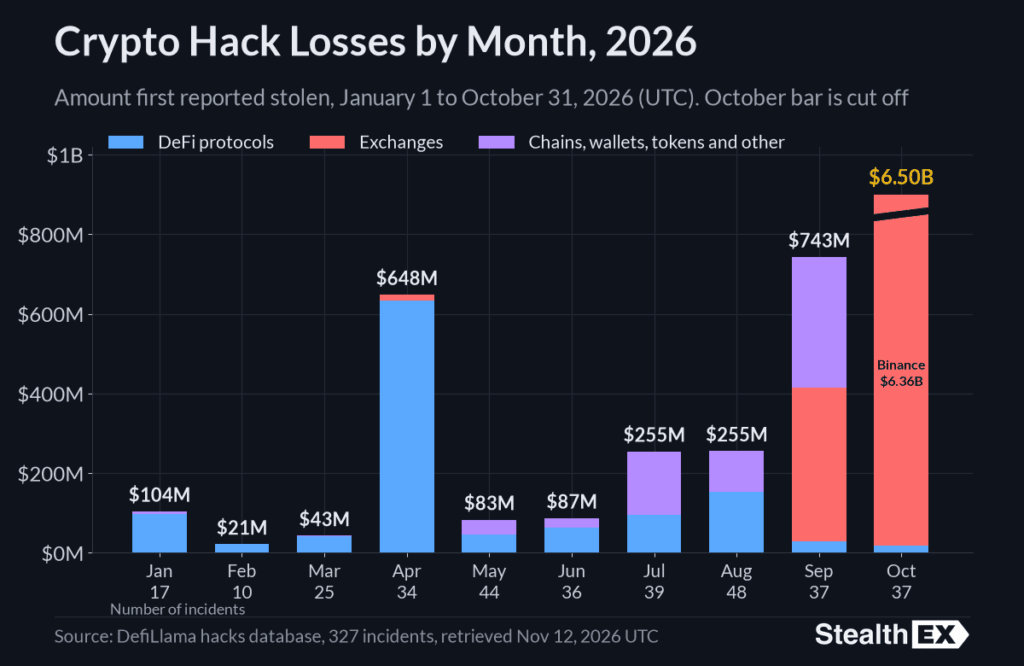
Hack losses by month, Jan 1 to Oct 31, 2026. Source: DefiLlama
January Through the Latest Verified Month
Crypto hacks in April 2026 cost about $648 million across 34 incidents. September reached about $743 million with Bitget and Liquid, and October about $6.5 billion. TRM’s headline about H1 losses below $1 billion covers January to June only.
| Period | Tracker | Reported stolen | Incidents |
|---|---|---|---|
| H1 (January to June) | TRM Labs | $972 million, less than half of the $2.3 billion in H1 2025 | 207 |
| Q3 (July to September) | CertiK | $1.28 billion | 255 |
| October | CertiK | $6.61 billion, or $3.72 billion after frozen and returned funds | Not given |
| January to October 30 | TRM Labs | $8.7 billion | Not given |
| January 1 to October 31 | DefiLlama | $8.74 billion | 327 |
What the January Update Adds
DefiLlama already lists the latest crypto hacks: 25 November incidents through November 16, worth about $60.8 million.
The largest are Mercado Bitcoin, an exchange, with $40 million on November 2, and Lighter Perps with $10.4 million through a compromised API key on November 16. Smaller cases include Kava Lend with $3.7 million through an arithmetic error on November 14, Arcus Perps with $2.2 million through a withdrawal flaw on November 10, and a DNS hijack of the Across frontend the same day.
Biggest Crypto Hacks of 2026
The biggest crypto hacks rank by the amount first reported taken, not by how often a story was reposted.
How to Read the Ranking
Binance alone is about 73% of the ten-month total. Without it, the largest crypto hacks 2026 produced are Bitget at $387.5 million, KelpDAO at about $292 million, and Drift at $285 million to $295 million.
Liquid ranks at about 4,000 BTC even though 3,400 BTC came back a day later, and Tectonic ranks at $120.4 million even though a rollback reversed $111.2 million. Where two sources differ, both figures appear: Step Finance is about $27 million at Defimon and $40 million at DefiLlama.
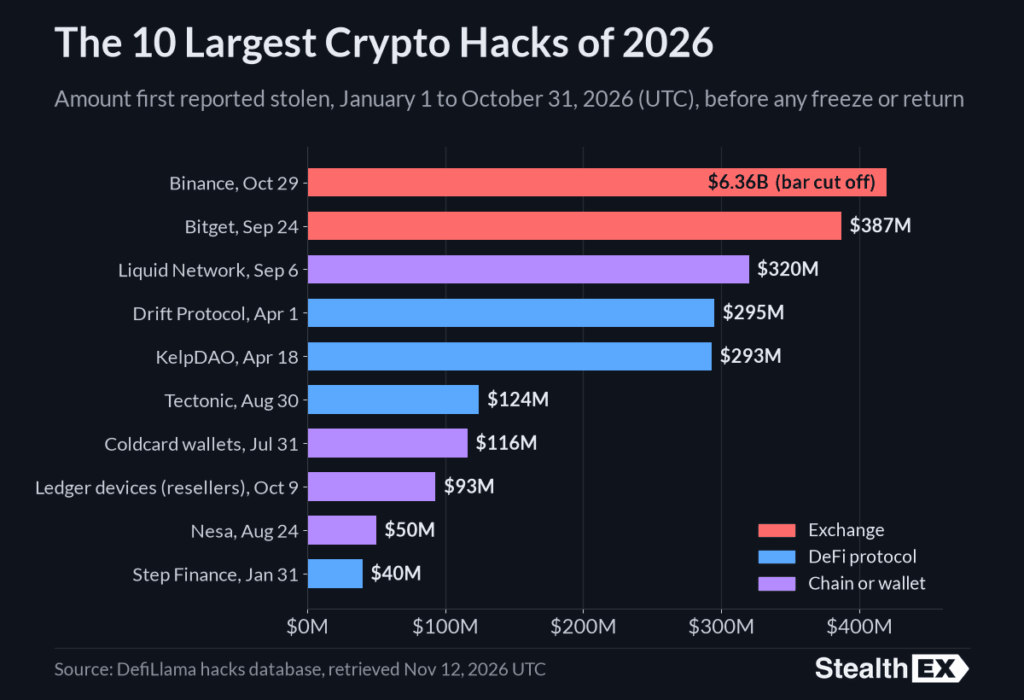
Largest hacks, Jan 1 to Oct 31, 2026. Source: DefiLlama
| Incident | Date (2026) | Amount first reported | Later frozen or returned | Source | Still unconfirmed |
|---|---|---|---|---|---|
| Binance, exchange | Oct 29 | About $6.3B (Binance), $6.36B (TRM) | Nearly $2.7B frozen by Oct 30, 00:30 UTC | TRM Labs | Full root cause |
| Bitget, exchange | Sep 24 | $351.6M first, revised to $387.5M | Some assets frozen, amount not given | Bitget | Who did it |
| Liquid Network, Bitcoin sidechain | Sep 6 | About 4,000 BTC | 3,400 BTC returned Sep 7, about 602 BTC outstanding | Blockstream | Attacker identity |
| KelpDAO, bridge | Apr 18 | 116,500 rsETH, about $292M | About 30,766 ETH (about $75M) frozen on Arbitrum | LayerZero, TRM Labs | Final laundering path |
| Drift Protocol, DeFi | Apr 1 | About $285M (TRM), $295M (DefiLlama) | Not reported | TRM Labs | Which North Korean subgroup |
| Tectonic, DeFi on Cronos | Aug 30 | $120.4M in borrowing | $111.2M reversed by a chain rollback, $9.19M escaped | The Block | Attacker identity |
| Coldcard wallets | From Jul 30 | About $116M from 5,200+ addresses | Not reported | Defimon | Number of victims |
| Step Finance, DeFi | Jan 31 | 261,854 SOL, about $27M (Defimon), $40M (DefiLlama) | About $4.7M recovered | Defimon | Final net loss |
Crypto Exchange Hacks in 2026
DefiLlama lists four exchange hacks in 2026 with $6.78 billion in reported stolen funds: Binance, Bitget, CoinDCX with $16 million on October 21, and Grinex with $13.74 million on April 16. In crypto exchange hack history, the Binance theft is about four times the $1.5 billion taken from Bybit in February 2025.
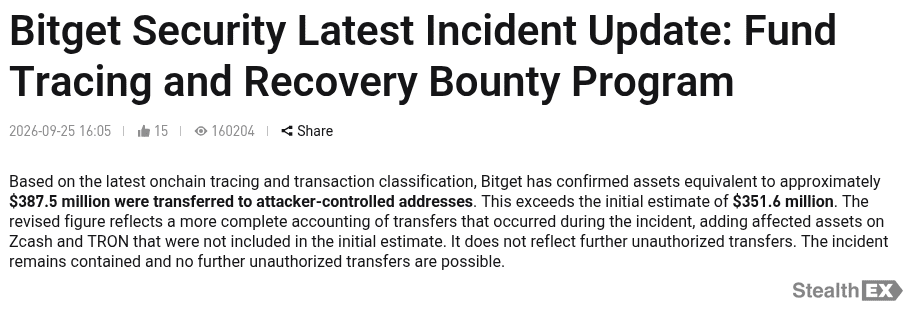
Bitget incident update, Sep 25, 2026. Source: Bitget
What an Exchange Hack Does and Does Not Mean
Crypto exchange hack news usually starts with a withdrawal pause, which is not proof of the amount stolen. DefiLlama classifies the Bitget, CoinDCX, and Grinex cases as hot-wallet key compromises, which reach the coins in those online wallets, not every customer balance.
Binance suspended withdrawals on several networks and said it covered the loss from its reserves, The Record reports. That is the company’s statement, and it has published no root cause or list of who was paid.
Bitget revised its loss from $351.6 million to $387.5 million and froze some assets without giving an amount. CoinDCX says it absorbed its loss. After any exchange hack, ignore direct messages that claim to be the exchange, and never send a seed phrase to anyone offering to trace funds. Fake support accounts are a second incident.
North Korea-Linked Crypto Hacks
TRM Labs estimates that North Korea crypto hacks took $7.4 billion in 2026, out of about $12.8 billion since 2017. That is 85% of all hack value this year, or 45% without Binance. On April 30, TRM had put the share at 76%, from just two attacks: Drift and KelpDAO, worth about $577 million.
Lazarus Group and What Is Still an Allegation
Lazarus Group is the analysts’ name for a set of North Korea-linked operations, and TraderTraitor is one Lazarus-linked unit. On October 31, the FBI and the US Secret Service publicly blamed TraderTraitor for the Binance theft and published the addresses it uses. That attribution is a government statement, not a court finding. TRM also counts Bitget as North Korean but calls the link not definitive, so Bitget stays suspected.
The $7.4 billion is the amount first stolen and excludes earlier years. The forensics firm Elliptic traced the Binance funds through about 12,000 wallets on 11 blockchains, The Record reports. TRM says the attacker still holds over 420,000 ETH and 18,270 BTC.
How the 2026 Hacks Happened
The typical cryptocurrency hack is a code exploit, 49% of incidents since 2022 in TRM’s data, but code exploits took only 15% of the value stolen. The big losses come from keys and signing systems, and DefiLlama’s 2026 classification shows the same split.
| Attack type (DefiLlama) | Incidents, Jan to Oct 2026 | Reported stolen |
|---|---|---|
| Frontend and infrastructure, including Binance | 16 | $6.5 billion |
| Key compromise | 37 | $721 million |
| Bridge and cross-chain | 34 | $701 million |
| Access control | 54 | $371 million |
| Token and share accounting | 58 | $251 million |
| Oracle manipulation | 42 | $75 million |
| All other types | 86 | $114 million |
Exploits, Keys, Bridges, and Phishing
Truebit lost funds through a vulnerability in an old mint contract, and Tectonic through a thin price feed. Drift fell to pre-signed admin transactions, and at Binance the attacker used 50 pre-signed authorizations on Ethereum. Coldcard users lost about $116 million to weak key generation.
KelpDAO shows the bridge case: attackers fed false data to the verifier that releases assets locked on another network. Phishing works on people instead, by getting them to sign a transaction or reveal a phrase.
| What happened | What the attacker reached | What it does not mean |
|---|---|---|
| DeFi protocol exploit | Funds the flawed contract, pool, or approval could move | Not every past user was drained |
| Exchange hack | Assets the venue held that the breach could reach | Not proof every balance is gone or will be repaid |
| Bridge exploit | Assets locked in that bridge | Not a rewrite of every other network |
| Phishing or a leaked key | The wallet or account whose secret or signature was taken | Not the same incident as a protocol breach |
| Stablecoin issuer freeze | That token, where the issuer can freeze it | Not a public-network undo, and not something you can trigger |
A Protocol Hack Is Not a Wallet Hack
Coins left with a custodian are exposed to its breach, and coins in a protocol to its contracts and any approval your wallet granted. Coins in a wallet you still control are not taken just because an exchange or protocol was hacked. If you used a hacked protocol, revoke its approvals, and do not deposit into a venue while it is handling an incident. The guides on securing your crypto wallet and seed phrases cover the setup.
What These Figures Do Not Decide
Trackers net out recoveries differently. CertiK puts October at $6.61 billion gross and $3.72 billion after frozen and returned funds. DefiLlama’s returned-funds field shows only about $6 million across nine incidents from January to October, so its $8.74 billion is close to a gross figure. Compare one tracker’s gross with another tracker’s gross, never with a net figure.
Returned Funds and Revised Totals
Within hours of the Binance theft, Tether froze about 1.77 billion USDT, Circle about 825 million USDC, Ripple 40.5 million RLUSD, and World Liberty Financial 27.8 million USD1. The Arbitrum Security Council froze about $30 million, TRM Labs reports.
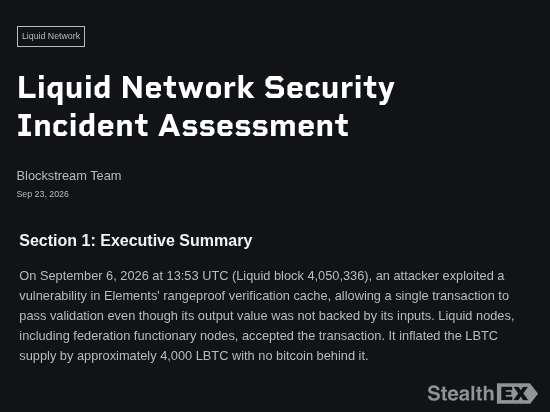
Liquid incident report, Sep 23, 2026. Source: Blockstream
Liquid’s 3,400 BTC came back from the attacker, not through a freeze. A stablecoin freeze works only on tokens with an issuer that can freeze them, so the ETH and BTC still held from Binance are out of reach.
Frequently Asked Questions
Which Months Does This 2026 Crypto Hacks Report Cover?
January 1 to October 31, 2026 (UTC), from the crypto hacks January 2026 brought, such as Truebit on January 8, to Binance on October 29. November and December incidents join the totals in January 2027.
What Is Counted as a Crypto Hack in the 2026 Totals?
A confirmed theft or exploit in which someone moved crypto without authorization, from a DeFi exploit to a crypto exchange hack security breach. Price drops, lost seed phrases, rumors, and rug pulls are left out. An incident reported in several stories counts once.
Do 2026 Hack Rankings Count Funds That Were Later Returned?
The ranking uses the amount first reported taken, and returned or frozen funds sit in a separate column. No net loss is calculated when a source gives only the gross figure.
Can a Public Blockchain Freeze Coins Stolen in a 2026 Hack?
No. A confirmed transfer on Bitcoin or Ethereum is final. Freezes come from an exchange, a custodian, or a stablecoin issuer such as Tether or Circle. After a DeFi hack, law enforcement may seek a seizure where it can reach the assets, but you cannot freeze or seize coins yourself.
What Should You Do First If Your Own Crypto Was Stolen in One of These Incidents?
If one of these recent crypto hacks hit you, save the transaction hash, addresses, amount, asset, network, and time. Never send a seed phrase or key to anyone offering recovery. If a named exchange still holds the deposit, use the contact on its own site. The guides on wallet security and seed phrases cover the next steps.
Does a DeFi Protocol Hack Drain Every Wallet That Interacted With It?
No. An exploit reaches only the funds the flawed contract, pool, or approval can move. A wallet that never approved that contract keeps its coins, though you should still revoke old approvals. A leaked seed phrase is a separate incident.
Conclusion
DeFi drove most incidents in 2026, 234 of 327, but one exchange theft at Binance drove most of the $8.74 billion. A headline amount is not a recovered amount: most of the $2.7 billion frozen at Binance came from stablecoin issuers, while the stolen ETH and BTC stayed with the attacker.
If you still control your crypto and need to move it, a standard crypto-to-crypto swap on StealthEX needs no account. The swap is wallet-to-wallet and non-custodial, with fixed or floating rates, and no coins are held after it completes. It cannot reverse a hack or freeze a public network. See how it works.
Don’t forget to do your own research before buying any crypto. The views and opinions expressed in this article are solely those of the author.
Binance crypto hack crypto world DeFi scamRecent Articles on Cryptocurrency