What Is Chainlink: Price Analysis and Tokenization Use Cases

Chainlink has moved far beyond simple price oracles. Today, it helps Web3 apps and traditional financial institutions connect data, assets, and blockchains in one secure framework. If you are asking what Chainlink is used for, the answer now includes DeFi, cross-chain transfers, Proof of Reserve, and real-world asset tokenization. In this article, you will learn how Chainlink works, why LINK matters, and how its 2026 market position may shape the next phase of on-chain finance.
Article contents
- 1 Understanding Chainlink Oracle Network
- 2 LINK Token: Utility and Economics
- 3 Chainlink Price Analysis: Historical Performance
- 4 Technical Price Analysis for LINK
- 5 Chainlink Price Outlook and Forecast Frameworks
- 6 Chainlink Core Services and Infrastructure
- 7 Chainlink CCIP: Cross-Chain Interoperability Protocol
- 8 Tokenization Use Cases: Chainlink’s Role in RWA
- 9 Chainlink Ecosystem and Integrations
- 10 Investment Evaluation: Is Chainlink a Long-Term Asset?
- 11 How to Buy and Trade LINK on StealthEX
- 12 Frequently Asked Questions
Understanding Chainlink Oracle Network
If you ask what is Chainlink oracle network, think of a secure data layer that now powers oracles, automation, privacy, and cross-chain logic.
How Does Chainlink Work in 2026
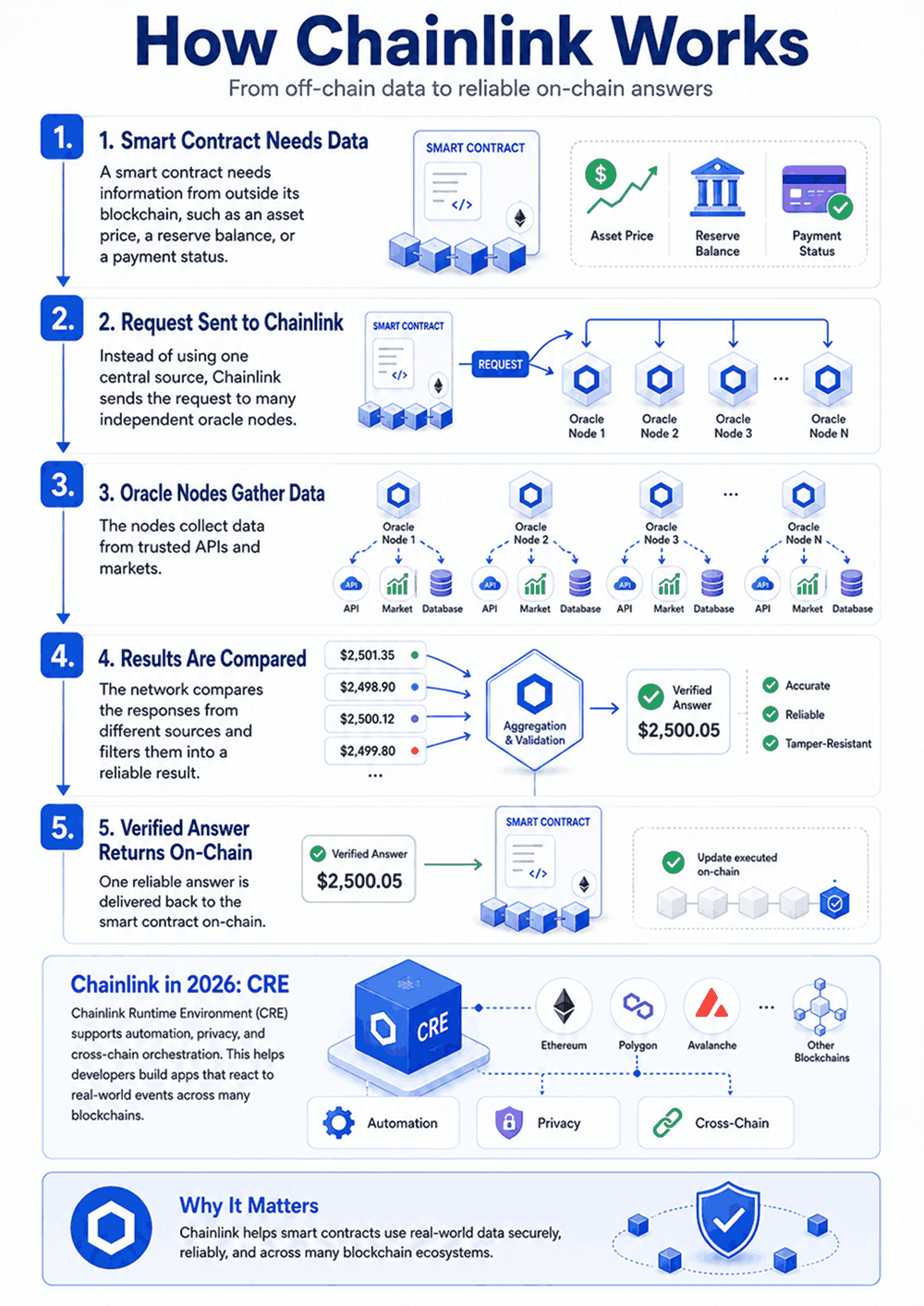
To understand how does Chainlink work, start with the data cycle. A smart contract needs information from outside its blockchain, such as an asset price, a reserve balance, or a payment status. Chainlink sends that request to many independent oracle nodes instead of one central source.
These nodes collect data from trusted APIs and markets, compare results, and deliver one reliable answer back on-chain. In 2026, Chainlink also uses CRE, or Chainlink Runtime Environment, to support automation, privacy, and cross-chain orchestration. This helps developers build apps that react to real-world events across many blockchains.
Chainlink Architecture and Decentralized Tech
A Chainlink decentralized oracle network uses DONs, or Decentralized Oracle Networks. Each DON works like a group of independent node operators that fetch, verify, and deliver data. This structure reduces the risk that one weak source can control the final result.
Chainlink node operators often run enterprise-grade infrastructure, which means they focus on uptime, security, and accurate reporting. The network also uses aggregation, reputation systems, cryptographic proofs, and economic incentives to limit manipulation. As a result, Chainlink gives smart contracts a safer way to use external data.
LINK Token: Utility and Economics
If you ask what is LINK crypto, think of LINK as the asset that powers payments, staking, and security inside the Chainlink network.
LINK Token Fundamentals & Standards
LINK gives Chainlink its economic layer. Developers use it to pay node operators, while node operators and community members can stake LINK to support network security. As Chainlink expands across blockchains, LINK also becomes more important as a payment and incentive asset for oracle services, automation, and cross-chain activity.
LINK uses the ERC-677 standard, which builds on ERC-20 and allows token transfers to carry extra data. This matters because smart contracts can receive LINK and trigger logic in one transaction, which makes Chainlink services easier to use. Chainlink’s own documentation describes LINK as an ERC-677 token that inherits ERC-20 functionality.
Tokenomics Overview & Supply Dynamics
Chainlink has a fixed maximum supply of 1,000,000,000 LINK, so the token does not have unlimited inflation. In 2026, live market trackers show around 748 million LINK in circulation, although this number can change as scheduled releases and ecosystem allocations move over time.
Staking also affects supply because locked LINK becomes less liquid on the open market. Chainlink Staking v0.2 launched with a 45 million LINK cap, split between community stakers and node operators. The Chainlink Reserve adds another demand channel because it converts on-chain and off-chain revenue into LINK.
| Supply Metric / Allocation | Value / Share | Economic Function & Market Impact |
| Total & Max Supply | 1,000,000,000 LINK | Hard-capped supply ceiling prevents long-term token dilution. |
| Circulating Supply | Around 748M LINK / about 74.8% | Active market liquidity used for paying node fees and regular trading. |
| Node Operator Incentives | Originally 35% | Distributed to secure early network growth; now increasingly supported by user fees. |
| Ecosystem Staking Pools | Scaled via Staking v2.X | Locks up circulating LINK to secure the network, reducing liquid market supply. |
| Chainlink Reserve | Programmatic LINK accumulation | Uses enterprise and on-chain revenue to support long-term network growth. |
Chainlink Price Analysis: Historical Performance
LINK’s price history shows how the project moved through hype, bear markets, and real adoption cycles before entering its 2026 phase.
Historical Price Milestones and Crypto Cycles
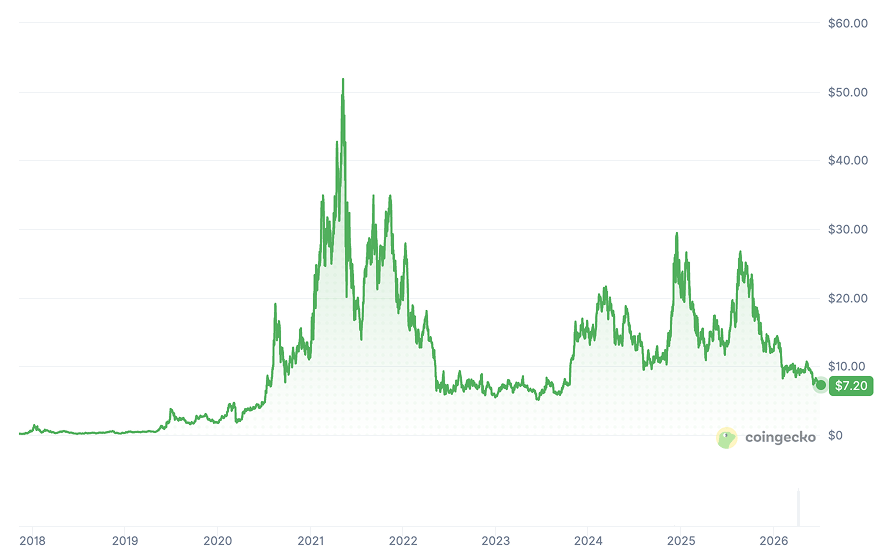
Chainlink began as a small oracle project in 2017, with LINK sold at about $0.0914 in its ICO. The token later rode the 2020 DeFi boom and the 2021 bull market, when LINK reached an all-time high of $52.7 in May.
After that, LINK followed the wider market lower. In 2023 and 2024, it moved into accumulation as investors watched staking, CCIP, and RWA infrastructure. In 2025, macro liquidity and rate expectations shaped price action, but Chainlink’s story also shifted from pilots toward production use cases.
CoinGecko, July 1, 2026
Key Value Drivers and Token Demand
The answer to why Chainlink is going up often starts with utility demand. Chainlink now supports DeFi, tokenized assets, Proof of Reserve, automation, and cross-chain messaging, so its role has moved beyond simple price feeds.
This shift matters because real usage can create recurring demand for Oracle services. More apps need secure data, reserve checks, and cross-chain transfers. Still, LINK price also depends on Bitcoin trends, market liquidity, and how much value Chainlink captures through fees, staking, and enterprise adoption.
Technical Price Analysis for LINK
Technical analysis helps readers compare LINK’s market structure with price trends, momentum signals, and key support zones.
Current 2026 Price Metrics and Market Position
As of the latest CoinGecko data, Chainlink trades near $7.2, with a market cap of about $5.4 billion and a fully diluted valuation near $7.2 billion. CoinGecko ranks LINK at #21 by market cap, which still places it among the largest and most liquid crypto assets.
The market cap / FDV ratio sits at 0.75, which means around three quarters of the fully diluted value already appears in the circulating market structure. CoinGecko also reports 748,099,970 LINK in circulation, against a total and maximum supply of 1,000,000,000 LINK.
| Market Metric | Current Value (2026 Data) | Significance for Investors |
| Current Price | $7.2 | Real-time valuation baseline reflecting macro crypto sentiment. |
| Market Capitalization | $5,385,297,150 | Represents the absolute market size and capital depth of the protocol. |
| Fully Diluted Valuation (FDV) | $7,198,633,024 | Shows the hypothetical value if all 1B LINK tokens were circulating. |
| Market Cap / FDV Ratio | 0.75 | Measures unlock pressure; a higher ratio means lower dilution risk. |
| Global Market Rank | #21 | Confirms Chainlink’s liquidity and scale among major digital assets. |
Technical Indicators & Market Momentum
Based on the monthly Investing.com data from July, 2026, LINK showed a Strong Sell summary. Moving averages also pointed to Strong Sell, with only 1 buy signal and 11 sell signals. Technical indicators looked weak too, with 0 buy signals and 8 sell signals.
RSI(14) stood at 39.944, which showed weak momentum but not full capitulation. MACD was negative at -1.33, while STOCH, STOCHRSI, and Williams %R all showed oversold conditions. This means sellers still controlled the trend, yet short-term exhaustion was visible.
Classic pivot levels placed support near $6.39 and resistance near $8.6. A stronger recovery would need LINK to reclaim the $8.6–$10 area. However, if price loses the $6.39 zone, the next deeper support levels sit near $5.6 and $4.19.
Chainlink Price Outlook and Forecast Frameworks
A useful answer to what is Chainlink price prediction starts with usage, fees, staking, and RWA adoption, not hype.
Short-Term Market Outlook (2026)
In 2026, the key question is how high Chainlink can go if adoption turns into real payment demand. The bullish case starts if bank tokenization pilots move into live production, CCIP usage grows, and staking pools absorb more circulating LINK.
A baseline range would keep LINK tied to the wider crypto cycle, with price reacting to Bitcoin, Ethereum, and DeFi liquidity. A bearish case could push LINK back toward lower support if regulation slows RWA launches or rival oracle networks gain share.
| Market Scenario | Key Macro & Fundamental Catalysts | Projected Network Valuation Impact |
| Bullish Case | Mass transition of bank pilots into live commercial RWA production via CCIP; major expansion of the programmatic fee-sharing model. | Structural buy-pressure heavily driven by organic enterprise demand and asset locking rather than retail speculation. |
| Baseline Case | Steady, linear adoption of CCIP within standard DeFi Layer-2 protocols; regular data feed renewals by top-tier dApps. | Balanced price movement tightly matching general Web3 sector growth and cyclical market trends. |
| Bearish Case | Regulatory bottlenecks delaying institutional RWA tokenization deployments; aggressive market-share capture by alternative oracles. | Price consolidation or testing lower support floors as speculative premiums temporarily cool off. |
Medium to Long-Term Projections Up to 2030
The question of what Chainlink will be worth in 2030 depends on whether Chainlink becomes core infrastructure for tokenized finance. In a strong bull case, CCIP could act like the “TCP/IP of finance,” helping banks, funds, and DeFi apps move value across networks with secure data and messaging.
A baseline case would still support long-term growth if Chainlink keeps its oracle lead, expands RWA integrations, and improves LINK fee capture. The bear case is simpler: strong technology may not guarantee token upside if competition grows or if enterprise usage does not create enough direct demand for LINK.
Chainlink Core Services and Infrastructure
If you ask what does Chainlink do, it provides the data, automation, reserve checks, and cross-chain tools that smart contracts need.
Chainlink Data Feeds and Data Streams
A Chainlink price oracle gives smart contracts reliable market data, such as token prices, exchange rates, or asset valuations. Chainlink Data Feeds deliver this data on-chain through decentralized oracle networks, so DeFi apps do not need to trust one exchange, one API, or one company.
Data Streams go further because they provide low-latency market data for faster on-chain markets. Chainlink positions Data Streams for perpetual futures, prediction markets, and tokenized markets that need quick updates and strong data integrity.
This matters in high-frequency DeFi. In Q1 2026, Chainlink reported that Polymarket launched 5- and 15-minute crypto markets powered by Data Streams, while Jupiter also appeared in Chainlink’s Data Streams ecosystem for real-time DeFi use cases.
Chainlink Proof of Reserve (PoR)
To understand how Chainlink Proof of Reserve works, imagine an automated reserve checker. PoR helps smart contracts verify whether an asset has enough backing, such as cash, crypto, gold, or another reserve asset.
This is useful for stablecoins, tokenized gold, wrapped Bitcoin, and other collateral-backed assets. If reserves fall below a required level, PoR data can help protocols pause minting, limit risk, or trigger protective logic before users face more serious damage.
Chainlink describes Proof of Reserve as automated, tamper-resistant reserve monitoring for digital assets. CACHE Gold is one example, because it uses Chainlink PoR to help verify that tokenized gold supply matches physical gold reserves.
Chainlink CCIP: Cross-Chain Interoperability Protocol
If you ask what Chainlink CCIP is, it is the secure messaging layer that helps blockchains move data, tokens, and instructions across networks.
Understanding CCIP Architecture and Security
CCIP Chainlink works as a cross-chain communication protocol. A smart contract sends a message from one blockchain, Chainlink oracle networks validate that action, and the destination chain receives the final instruction. This allows apps to move tokens, data, and commands without building a custom bridge for every chain.
Security is the key difference. CCIP uses Chainlink’s decentralized oracle infrastructure and adds the Risk Management Network, an independent secondary layer that monitors cross-chain activity for abnormal behavior. This watchdog design helps reduce bridge risk and gives institutions a stronger safety model for tokenized finance.
CCIP Use Cases: Cross-Chain Token Standard
One of the most important Chainlink use cases is the Cross-Chain Token, or CCT, standard. It lets developers connect existing or new tokens to CCIP in a more self-serve way, which makes cross-chain token transfers easier to launch and manage.
CCTs can support programmable token transfers, direct staking flows, and unified multi-chain dApps. For example, a protocol can move a token across chains and attach extra instructions, such as compliance data or app-specific logic. This helps developers build one connected product instead of separate versions for every blockchain.
Tokenization Use Cases: Chainlink’s Role in RWA
RWA tokenization turns traditional assets into blockchain-based instruments, and Chainlink supplies the data, reserve checks, and messaging layer they need.
The State of Real-World Asset Tokenization
Real-world asset tokenization means that assets such as Treasuries, private credit, funds, real estate, or gold can exist as blockchain-based tokens. This gives institutions a way to improve settlement, transparency, and collateral movement.
By July 2026, RWA.xyz showed $27.65 billion in distributed tokenized asset value and $441.38 billion in represented asset value, excluding ordinary crypto speculation. McKinsey also estimated that tokenized financial assets could reach around $2 trillion by 2030, with a bullish case near $4 trillion.
Chainlink’s Unified Institutional Infrastructure
Chainlink matters because institutions need more than a token contract. They need asset prices, reserve data, compliance logic, and secure movement between private and public blockchains. Chainlink combines these layers into one infrastructure stack.
Data Feeds can publish market prices and fund data. Proof of Reserve can verify whether a tokenized asset has real collateral behind it. CCIP can move tokens and messages across chains. Together, these tools help banks and asset managers build products that feel closer to traditional finance but settle with blockchain speed.
TradFi Integration and Global Financial Infrastructure
If you ask who uses Chainlink, the answer now includes major financial infrastructure firms, banks, and asset managers. Chainlink has worked with Swift, DTCC, Euroclear, UBS, ANZ, Fidelity International, Sygnum, and other institutions on tokenization, settlement, and data delivery.
DTCC’s Smart NAV pilot used Chainlink CCIP to bring trusted NAV data to blockchains, while Fidelity International and Sygnum worked with Chainlink to publish NAV data for a tokenized fund structure. These examples show why Chainlink is becoming a bridge between capital markets and on-chain finance.
Chainlink Ecosystem and Integrations
Chainlink’s ecosystem shows its network effect: more chains, more apps, and more institutions rely on its data and messaging tools.
DeFi Integration Landscape Total Value Secured
Chainlink is often measured by Total Value Secured, or TVS, instead of TVL. TVL tracks assets deposited inside protocols, while TVS tracks value that depends on Chainlink services, including price feeds, cross-chain messaging, and reserve verification.
In May 2026, Chainlink’s TVS crossed $110 billion, with more than $60 billion in cross-chain tokens and around $50 billion in DeFi data feeds. This shows that Chainlink does not only serve one niche. It secures lending markets, derivatives, tokenized assets, and multi-chain applications.
Messari also reported that Chainlink had enabled more than $26 trillion in cumulative transaction volume by October 2025. That figure matters because it shows long-term infrastructure usage, not just short-term market speculation.
| Sector / Core Protocol | Primary Chainlink Service Used | Infrastructure & Security Role |
| Lending Markets (e.g., Aave V4, Compound) | Decentralized Data Feeds | Prevents bad debt by delivering tamper-proof, real-time collateral liquidation prices. |
| Perpetuals & Derivatives (e.g., Jupiter, GMX) | Low-Latency Data Streams | Powers high-frequency execution and execution pricing, neutralizing front-running risks. |
| Cross-Chain Apps (e.g., Multi-chain dApps) | CCIP (Cross-Chain Protocol) | Enables secure, native asset routing and arbitrary data messaging across isolated layers. |
| Tokenized Assets & RWA (e.g., Securitize, Funds) | Proof of Reserve (PoR) & CCIP | Automatically verifies real-world collateral backing before enabling cross-chain asset movement. |
Multi-Chain Expansion & Blockchain Support
Chainlink follows a multi-chain strategy because DeFi, RWA tokenization, and on-chain trading no longer happen on one blockchain. Developers need the same reliable infrastructure across L1s, L2s, appchains, and non-EVM networks.
The ecosystem includes major chains and scaling networks such as Ethereum, Arbitrum, Base, BNB Chain, Avalanche, Polygon, Solana, Aptos, Tron, Sei, Hedera, Ronin, ZKsync, and Hyperliquid’s HyperEVM. Chainlink’s own ecosystem pages position the network as infrastructure for blockchain ecosystems that want secure data, automation, and cross-chain connectivity.
So, how many blockchains does Chainlink support? A simple reader-friendly answer is 15+ major blockchain ecosystems, with broader integration counts reaching much higher when protocols, services, and deployment environments are included. This scale gives Chainlink a strong distribution advantage because each new chain increases demand for shared oracle and cross-chain standards.
Investment Evaluation: Is Chainlink a Long-Term Asset?
The question is whether Chainlink is a good investment, which depends on utility growth, token demand, risks, and portfolio fit.
Fundamental Investment Thesis
The main case for Chainlink starts with its role as infrastructure. Chainlink already serves DeFi, data feeds, CCIP, Proof of Reserve, and institutional tokenization, so it has a deep competitive moat. Chainlink also describes itself as the industry-standard oracle platform powering much of DeFi and bringing capital markets on-chain.
For investors asking should I buy Chainlink, the key point is simple: LINK becomes more interesting if network usage turns into stronger token demand. Chainlink Economics 2.0 focuses on value capture, staking, and sustainable oracle revenue, which may support long-term utility if adoption keeps expanding.
Risk Management and Headwinds
Chainlink still carries clear risks. The biggest one is the “good tech vs token capture” debate. A network can become widely used, yet LINK may underperform if service fees, staking demand, and reserve accumulation do not create enough direct buy pressure.
Competition also matters. Oracle and data networks such as Pyth, Chronicle, and other specialized providers may win market share in certain niches. Regulation can slow RWA tokenization too, because real-world assets still depend on custody, legal claims, compliance, and off-chain verification. Recent RWA research highlights these legal and technical gaps across tokenized asset systems.
Portfolio Integration and Correlation
For beginners, asking if Chainlink crypto is a good investment, LINK should not be viewed like a bond or low-risk income asset. It remains a volatile crypto asset, and it often follows Bitcoin, Ethereum, liquidity cycles, and broader altcoin sentiment.
That said, LINK also has a separate infrastructure thesis. Long-term holders may treat it as a bet on oracle demand, RWA tokenization, and cross-chain finance. A balanced approach would use position sizing, staged entries, and clear risk limits instead of relying on one price prediction.
How to Buy and Trade LINK on StealthEX
StealthEX gives users a simple way to exchange LINK without holding funds on a centralized trading account.
Why Choose StealthEX for LINK Trading
StealthEX fits users who want a direct and simple LINK swap process. The platform is an instant crypto exchange that does not require registration and does not store user funds on the platform. It also supports more than 2,000 coins and tokens for quick exchanges.
This matters because beginners do not need to manage complex order books. They choose the asset they want to send, select LINK as the asset they want to receive, and provide their wallet address. Since swaps are non-custodial, users keep more control over their crypto during the process.
Step-by-Step Guide to Exchange LINK
- Open StealthEX and choose the cryptocurrency you want to exchange for LINK.
- Select LINK as the asset you want to receive.
- Enter the amount, then compare the estimated exchange result.
- Paste your Chainlink wallet address carefully.
- Send your crypto to the deposit address shown by StealthEX.
- Wait for the swap to complete and check your wallet balance.

Before confirming the swap, always check the network, wallet address, and final amount. Crypto transactions cannot be reversed, so one small mistake can lead to a permanent loss of funds.
Frequently Asked Questions
What Is Chainlink and How Does It Work?
Chainlink is a decentralized oracle network that connects smart contracts with external data. It uses many independent nodes to collect, verify, and deliver information on-chain. This helps blockchain apps use prices, reserves, payments, and cross-chain messages without trusting one central data source.
How Does Chainlink’s Technology Influence LINK Market Value?
Chainlink’s technology can influence LINK value when network usage grows. Developers pay for services, staking can lock supply, and Chainlink Economics 2.0 supports fee-sharing models. If demand for oracles, CCIP, and RWA infrastructure rises, LINK may gain stronger utility-based demand.
What Role Does Chainlink Play in RWA Tokenization?
Chainlink supports RWA tokenization through three key services. Proof of Reserve verifies asset backing, Data Feeds provide market valuations, and CCIP enables secure cross-chain transfers. Together, these tools help traditional finance connect real-world assets with blockchain infrastructure.
What Is Chainlink CCIP and Why Is It Critical?
CCIP, or Cross-Chain Interoperability Protocol, lets blockchains send tokens, data, and instructions across networks. It is critical for RWA because tokenized assets need liquidity across many chains. CCIP also uses stronger security layers than many standard crypto bridges.
How Does CCIP Integration Impact LINK Tokenomics?
CCIP can support LINK tokenomics by increasing demand for Chainlink services. As more apps move assets and messages across chains, they create more payment activity inside the network. Over time, this may strengthen LINK’s role as a core infrastructure token.
Follow us on Medium, X, Telegram, YouTube, and Publish0x to stay updated about the latest news on StealthEX.io and the rest of the crypto world.
Don’t forget to do your research before buying any crypto. The views and opinions expressed in this article are solely those of the author.
blockchain oracle Chainlink LINK coin RWA tokenizationRecent Articles on Cryptocurrency