Why Is the Crypto Market Down Today?



Crypto is moving lower today because investors are stepping away from risky assets. A sharp sell-off in global technology and semiconductor shares has spread into the digital asset market, while renewed tensions in the Middle East and rising oil prices have added to inflation fears. Bitcoin has slipped below $63,000, and major altcoins have followed it lower. So, why is the crypto market down today? The short answer is weaker risk appetite, concern about the wider economy, and continued selling pressure. The decline looks serious, but one difficult session alone does not confirm a lasting crash. In this article, we will explain what is driving the move, how it affects different coins, and what could happen next.
Article contents
What Happened to the Crypto Market Today?
The cryptocurrency market followed a clear risk-off pattern. Selling strengthened during the Asian session as semiconductor shares fell sharply, then spread across Bitcoin, Ethereum, and most large altcoins. Buyers appeared after the initial decline and lifted several assets from their intraday lows, but the rebound was not strong enough to erase the daily losses.
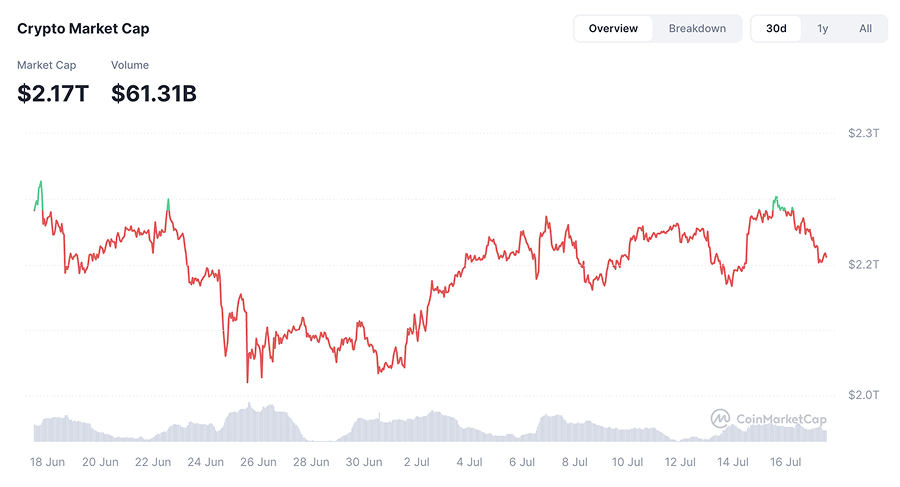
Crypto Market Cap, CoinMarketCap, July 17, 2026
At the time of the latest update, the total crypto market capitalization stood near $2.17 trillion, down 1.34% over 24 hours. Bitcoin represented 58.35% of that value, showing that capital remained concentrated in the market’s largest asset. Total trading volume reached $61.94 billion, a 16.07% decline from the previous day.
So, what happened to crypto today? The market moved through three stages: an early retreat, a sharper fall as global risk sentiment worsened, and a modest recovery from the lowest prices.
Why Is Crypto Down Today?
Crypto is down because investors are reassessing how much risk they want to hold. The immediate trigger came from traditional markets, where a sell-off in semiconductor and artificial intelligence stocks challenged one of the year’s strongest investment themes. Many funds treat crypto as a speculative asset, so they often reduce digital-asset exposure when volatility rises in equities.
Geopolitical uncertainty created a second source of pressure. Renewed military action involving the United States and Iran increased concern about oil supplies. More expensive energy can push consumer prices higher, which may encourage central banks to keep borrowing costs elevated. Higher rates make cash and government bonds more competitive with assets that do not generate predictable income.
The market was also vulnerable before today’s session. Bitcoin had recently recovered after softer U.S. inflation data, but that improvement depended on investors maintaining a positive view of monetary policy. The shift in global sentiment removed that support before the rally could develop.
Therefore, the answer to why is crypto down is not a blockchain failure or one negative industry announcement. It is a rapid change in expectations across several connected markets. Investors are protecting capital while they assess technology valuations, energy prices, geopolitical risk, and the next decisions from the Federal Reserve.
Bitcoin and Major Cryptocurrency Price Drops
Right now, Bitcoin trades near $62,800 after moving between $62,620 and $64,830. Its 24-hour loss stood at 1.3%, but the recovery of about $20 0 from the low showed some demand below $63,000.
Ethereum traded at $1,812 after reaching $1,890 earlier and falling as low as $1,808, leaving it down 2.5%. Solana changed hands at $73.7 within a $73.7–$76.7 range, while XRP stood near $1.07 after touching $1.12. BNB fell 2.5% to $558, and Dogecoin declined 1.55% to $0.071.
HYPE recorded the sharpest crypto price drop today. It traded near $59.8 after moving between approximately $59.5 and $66.1, losing 9%. The difference shows that higher-risk tokens can react much more strongly than Bitcoin during the same session.
Market Sentiment and Investor Behavior
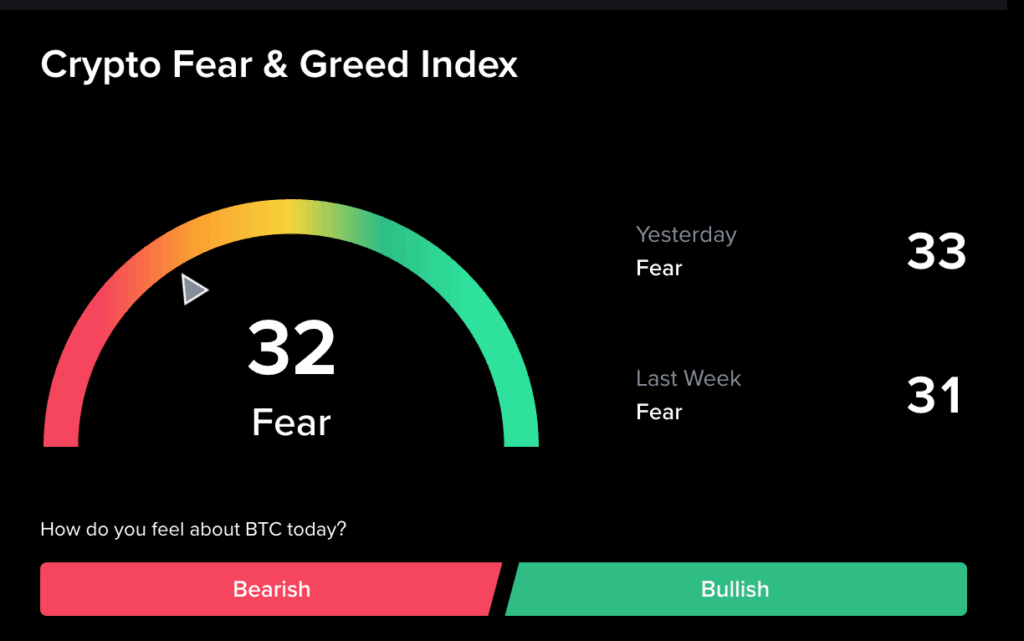
Market sentiment weakened, but the available indicators do not show complete panic. The Binance’s Crypto Fear and Greed Index fell from 33 to 31 out of 100. Both readings remain in the “Fear” category, while a move below 25 would normally indicate “Extreme Fear.”
Trading activity provides additional context. Market-wide volume declined 16.07% instead of rising during the sell-off. Heavy panic usually brings a sudden increase in transactions as investors rush to exit. Today’s lower volume suggests a different situation: many potential buyers are waiting, while existing sellers can move prices with less resistance.
During this crypto market decline, investors appear defensive rather than desperate. They have reduced exposure, avoided aggressive new positions, and watched whether the recovery from the daily lows can last.
Macroeconomic and Market Factors
Pressure from traditional markets was unusually visible. Taiwan’s stock index plunged more than 6%, China’s CSI 300 fell 3.6%, and Japan’s Nikkei lost 4%. U.S. futures pointed in the same direction: the Nasdaq was down 2.2%, while the S&P 500 was 1.1% lower before the opening bell.
Oil added a separate inflation risk. Brent crude rose to $84.75 per barrel and U.S. crude reached $79.80. Both benchmarks headed for weekly gains above 11% after fresh attacks involving Iran and U.S. forces. Crypto often struggles when falling equities and rising energy prices occur together because investors expect slower growth, persistent inflation, and less supportive central-bank policy.
Why Are Crypto Prices Falling Right Now?
The initial news explains why the market turned lower, but market structure explains why the pressure continued. Bitcoin’s earlier rebound had failed to establish firm support above its short-term trend. During today’s decline, the price moved below its 50-day moving average, a level used by traders and automated strategies to measure momentum.
When that signal weakened, some participants closed positions. At the same time, cautious investors placed buy orders farther below the market instead of purchasing immediately. This widened the gap between sellers and nearby buyers. Even a normal sell order could then produce a larger price movement.
Lower market-wide volume reinforces this interpretation. The decline did not attract enough fresh spot demand to build a durable recovery. The bounce from the session lows showed that buyers were present, but they focused on cheaper entries rather than chasing prices upward.
This explains why crypto prices are falling after the first reaction to the news. The market needs time to rebuild an order book with stronger demand. Until that happens, short rebounds may stall as traders who bought earlier use them to reduce exposure.
Liquidations and Short-Term Volatility
Leverage increased the speed of some movements without becoming the main cause of the session. CoinGlass recorded $370 million in liquidations across 68,267 traders over 24 hours. A liquidation occurs when an exchange automatically closes a borrowed position because the trader’s collateral cannot cover the loss.
For perspective, the June 2 sell-off erased roughly $1.8 billion in leveraged positions. Today’s total equals about 13% of that amount. Therefore, crypto falling today does not reflect an exceptional liquidation cascade. Forced closures added pressure near the lows, but weaker spot demand and the global risk-off move played larger roles.
Institutional Activity and Market Flows
Institutional demand produced a more positive signal than prices suggested. U.S. spot Bitcoin ETFs attracted $107.7 million on July 15 and $79.1 million on July 16. Together, the funds gained $186.8 million before today’s session. Spot Ethereum ETFs also collected almost $97 million during the first three days of the week.
These flows show that professional investors have not abandoned the market. However, they follow a difficult first half of 2026. Citi reported $3.3 billion in net Bitcoin ETF outflows for the year through July 1. Two positive sessions improve the short-term picture, but a longer sequence of inflows would be necessary to confirm that institutional demand has changed direction.
Is the Crypto Market Crashing or Is It a Normal Dip?
A crash describes more than a red daily chart. It normally involves a fast loss of value, disappearing liquidity, widespread forced selling, and failing market infrastructure. A correction is an orderly decline that removes part of a previous advance while exchanges continue operating normally.
The current session fits the second description more closely. Most leading cryptocurrencies recorded low-single-digit losses, even though one higher-risk token fell much further. Trading continued without a major exchange failure, stablecoins maintained their intended values, and buyers returned after the morning decline.
The wider trend still deserves caution. Bitcoin remains far below its October 2025 record, and repeated recoveries have struggled to continue. However, long-term weakness does not turn every negative session into a fresh collapse.
Anyone searching for a crypto market crash today should separate the daily move from the broader bear market. Today brought a coordinated retreat and clear risk aversion, but its speed, liquidity, and normal market operation still resemble a correction rather than a disorderly crash.
Signs of a Market Correction
The intraday recovery offers the clearest sign of an orderly crypto market dip. Bitcoin rose about 1.1% from its daily low to the latest price, while Ethereum recovered roughly 0.7% and Solana gained around 0.8% from their weakest levels. These rebounds were modest, but they showed that buy orders remained available.
The market also avoided a major stablecoin depeg, exchange outage, or sudden breakdown in settlement. Those details matter more than a red percentage alone. A normal correction can remain uncomfortable and continue for several sessions, yet it still allows buyers and sellers to transact without severe market stress.
Factors That Could Signal a Deeper Decline
A daily close below $62,000 would weaken the recent trading range, while a decisive break under $60,000 could expose the late-June low near $57,750. The quality of any break matters: high volume, repeated failed rebounds, and accelerating outflows would make it more meaningful than a brief intraday move.
Other warning signs include the sentiment index entering Extreme Fear, stablecoins losing their pegs, or liquidations moving back toward billion-dollar levels. Stress at a large exchange or a major corporate Bitcoin holder would add a separate structural risk. If several of these signals appear together, the answer to why crypto is crashing today would extend beyond normal volatility.
Will the Crypto Market Recover?
The crypto market can recover, but the path depends on which pressure changes first. One scenario involves traditional markets stabilizing after the semiconductor sell-off. If investors regain confidence in equities, they may become more willing to hold digital assets.
A second path depends on monetary policy. The Federal Reserve meets on July 28–29, and investors will look for guidance on inflation and future rates. Softer economic data could improve liquidity expectations, while a restrictive message could keep crypto under pressure.
Geopolitical developments create a third scenario. A reduction in U.S.-Iran tension could lower the risk premium in energy markets and support a return to speculative assets. Continued escalation would have the opposite effect.
Investors asking whether the crypto market will recover should remember that recovery can take different forms. Prices may rebound after external conditions improve, or remain in a range while demand rebuilds. Bitcoin and established networks could stabilize before speculative tokens. A genuine recovery would begin with calmer daily movements and consistent buying, not simply one sharp green candle.
Factors That Could Support Recovery
The first constructive signal would be Bitcoin closing above $65,000, the area that stopped two recent advances. A move beyond the June 15 high near $67,250 would then create a stronger pattern of higher highs. On the downside, holding the current trading range would allow buyers time to rebuild positions.
A healthy crypto recovery would also require volume to expand during price increases rather than during declines. Continued ETF inflows, improving market breadth, and stronger performance from Ethereum and large altcoins would confirm that demand extends beyond Bitcoin. Progress on U.S. market-structure legislation could provide an additional catalyst.
Why Crypto Volatility Can Continue
Crypto volatility can continue even if the main news becomes quieter. The market trades 24 hours a day, while liquidity changes significantly between Asian, European, and U.S. sessions. A large order placed during a quieter period can therefore move prices more than the same order during peak activity.
Leverage adds another source of instability because exchanges can close positions automatically. Correlations also change quickly: crypto may follow technology shares during one session and respond to ETF flows or regulation during the next. These features explain why crypto is down so much at one point, then recovering hours later without a major new announcement.
How Crypto Market Drops Affect Different Cryptocurrencies
Market capitalization explains why the sell-off produces different results. Bitcoin is worth approximately $1.3 trillion, giving it the deepest pool of buyers and sellers. Ethereum’s capitalization is about $221 billion, while XRP stands near $67.7 billion and Solana near $43.6 billion. Smaller markets require less capital to create a large percentage move.
The type of asset also matters. Bitcoin often acts as the market’s defensive crypto holding. Ethereum, Solana, and other smart-contract assets respond to expectations for network use, DeFi, and applications. Meme coins depend more heavily on attention and speculative demand, so that demand can disappear quickly.
Stablecoins behave differently because their issuers aim to keep them close to a fixed value, usually one U.S. dollar. They face reserve and depegging risks instead of normal market-direction risk. Therefore, when the cryptocurrency market is down today, investors should examine liquidity, capitalization, token supply, and purpose rather than assume every asset will follow the same path.
FAQ
Why Is Crypto Down Today?
Crypto is down today because investors have reduced risk after a global technology sell-off and renewed geopolitical tension. Higher energy prices have added inflation concerns, while weak buying activity has allowed sellers to control the short-term direction.
Why Is Crypto Crashing Today?
The market is falling, but current conditions look closer to a correction than a disorderly crash. Exchanges continue to operate, stablecoins remain broadly stable, and buyers returned near the session lows. A deeper loss of support could change that assessment.
What Happened to Crypto Today?
Selling began during the Asian session, intensified as global equity markets weakened, and later slowed when buyers entered near the daily lows. Prices recovered part of the decline, but the rebound did not restore the levels seen at the start of the session.
Why Are All Cryptocurrencies Down Today?
The answer to why all crypto is down today lies in shared liquidity and investor behavior. When risk appetite falls, traders often reduce several positions at once. Large cryptocurrencies usually decline less, while smaller and more speculative tokens can experience much sharper moves.
Is the Crypto Market Going to Recover?
Recovery remains possible if traditional markets stabilize, geopolitical pressure eases, and sustained demand returns. However, the process may begin with a sideways trading range rather than an immediate rally. Some weaker tokens may not recover with the broader market.
Make sure to follow StealthEX on Medium, X, Telegram, YouTube, and Publish0x to stay updated about the latest news on StealthEX.io and the rest of the crypto world.
Don’t forget to do your own research before buying any crypto. The views and opinions expressed in this article are solely those of the author.
Bitcoin crypto bear market crypto market cryptocurrency market EthereumRecent Articles on Cryptocurrency
 What Will Ethereum Be Worth By End of 2026?