
Sky Price Prediction: Is SKY Coin a Good Investment?


If you are curious about SKY price prediction, you are not alone. Many beginners want to know whether this token has growth potential or if it’s just another short-lived trend. In this article, we will look at what Sky is, how it works, and where its price might go in the future.
Right now, Sky crypto trades around $0.063. Over the last week, it dropped to $0.055 on January 13 and climbed as high as $0.067 on January 19. That means the price moved about 20% from its low to its high in just a few days. Such swings are normal in the crypto market, but they also show how quickly opportunities and risks can appear.
The goal of this article is to explain SKY in simple terms. Even if you are new to crypto, you will understand what this token does, why people follow it, and what experts expect for the years ahead. Instead of confusing jargon, you will get clear insights that help you decide if Sky is worth watching or even investing in.
In the next parts, we’ll cover the project’s background, its main functions, past price movements, and future predictions. By the end, you will have a better idea of where Sky might be heading.
| Current SKY Price | SKY Price Prediction 2026 | SKY Price Prediction 2030 |
| $0.063 | $0.1 | $0.35 |

Article contents
- 1 Sky (SKY) Overview
- 2 Sky (SKY) Features
- 3 SKY Price Chart
- 3.1 2017 – The Early Days of MakerDAO’s MKR
- 3.2 2018 – Boom and Crash
- 3.3 2019 – Slow Recovery
- 3.4 2020 – The DeFi Summer Surge
- 3.5 2021 – Record-Breaking Rally
- 3.6 2022 – Turbulence and Uncertainty
- 3.7 2023 – Post-Crisis Struggles
- 3.8 2024 – Modest Rebound
- 3.9 2025 – Endgame Transition and Pullback
- 3.10 2026 – New Achievements and New Heights
- 4 Sky Price Prediction: 2026, 2027, 2030–2040
- 5 Sky Price Prediction: What Do Experts Say?
- 6 SKY USDT Price Technical Analysis
- 7 What Does the Sky Price Depend On?
- 8 Sky (SKY) Price Prediction: Questions and Answers
- 9 How to Buy SKY Coin? Quick-Step Guide
Sky (SKY) Overview
Sky (SKY) is an open financial protocol built on Ethereum, created as part of Rune Christensen’s “Endgame” plan that transformed the well-known MakerDAO into a new ecosystem in 2025. At its core, Sky introduces two main elements: the stablecoin USDS and the governance token SKY. USDS is a soft-pegged dollar stablecoin backed by overcollateralized assets such as ETH, while SKY gives holders the right to govern the protocol, vote on key parameters, and take part in reward mechanisms.
The story of Sky started long before the rebrand. Since 2015, MakerDAO has been one of the most important projects in decentralized finance. By 2025, Christensen launched the new identity Sky to simplify governance, expand functionality, and bring DeFi to a broader user base. His vision was to create a cleaner, more user-friendly structure where participation and decision-making would be easier for both institutions and retail users.
Sky works through decentralized liquidity pools. Users deposit assets such as ETH as collateral to mint USDS, which is then used like a stablecoin across the DeFi space. Governance happens fully on-chain. SKY holders can propose and vote on system changes such as adding new collateral types, adjusting interest rates, or modifying savings mechanisms.
One of the standout features is the Sky Savings Rate (SSR). By depositing USDS into smart contracts, users receive sUSDS, which automatically grows in value to reflect earned interest. Another component is Sky Token Rewards (STR), where providing USDS liquidity earns rewards in SKY. These functions are designed to keep the ecosystem active and self-sustaining.
Sky also introduces SkyLink, a bridge that connects Ethereum with major Layer 2 solutions like Arbitrum, Optimism, Base, and Unichain. This reduces fees and speeds up transactions, making USDS and SKY more practical for everyday use.
The ecosystem is accessed through Sky.money, a non-custodial hub for trading, savings, staking, and governance. Beyond the core protocol, independent projects known as Sky Stars extend its reach. Spark, for example, helps allocate liquidity between DeFi, centralized platforms, and real-world assets.
From a tokenomics perspective, the shift from MakerDAO was dramatic: each MKR was converted into 24,000 SKY, lowering the barrier for governance. No additional SKY tokens are minted beyond this conversion. Supply remains capped, while USDS is minted and burned dynamically based on demand.
The mission of Sky is clear: promote non-custodial DeFi where users keep control of their keys, simplify governance with transparent voting, and provide integrated tools for saving, staking, and liquidity. It positions itself as a full ecosystem rather than just a lending protocol, with a long-term focus on sustainable growth and user empowerment.
SKY Price Statistics
| Current Price | $0.063 |
| Market Cap | $1,455,202,758 |
| Volume (24h) | $26,677,811 |
| Market Rank | #50 |
| Circulating Supply | 22,991,702,723 SKY |
| Total Supply | 23,462,665,147 SKY |
| 1 Month High / Low | $0.069 / $0.055 |
| All-Time High | $0.1014 Dec 04, 2024 |
Sky (SKY) Features
Sky (SKY) offers a wide range of functions that make it more than just another governance token. At its foundation, it runs on Ethereum using permissionless smart contracts. This structure ensures that all operations remain transparent and reliable, with no central party controlling how the system works. The integration with Layer-2 networks through SkyLink further expands usability. By connecting to chains like Arbitrum, Optimism, and Base, transactions become faster and cheaper than those on Ethereum alone, which makes the protocol more accessible for everyday users.
Privacy is also part of the design. Zero-knowledge proofs allow certain transactions to stay confidential without compromising overall transparency. This option appeals to users who value privacy while still operating in a decentralized environment. Trading and yield generation are powered by open liquidity pools. These pools remove the need for intermediaries and allow direct token swaps, stablecoin borrowing, or earning returns from deposited assets.
The Sky.money interface acts as the main hub where users interact with the protocol. Here, they can upgrade MakerDAO’s legacy MKR into SKY, swap cryptocurrencies for SKY or USDS, and deposit USDS into the Sky Savings Rate module to earn interest. The interface also supports staking SKY for governance participation and rewards, and it allows borrowing USDS by locking SKY as collateral. This design keeps control fully in the hands of users, avoiding custodial risks.
Sky operates as a dual-token system. The first is SKY, the native governance token, created by converting MKR at a 24,000-to-1 ratio. It gives holders the power to vote on protocol parameters, upgrades, and specialized proposals. The second is USDS, a stablecoin soft-pegged to the U.S. dollar. It is backed by both crypto and traditional assets, designed to maintain value stability across different markets.
The governance structure is decentralized and community-driven. Decisions follow the Sky Atlas governance handbook and can involve subDAOs focused on specific tasks. This layered approach makes the system more adaptive and resilient. Importantly, all actions remain transparent and non-custodial, with users always keeping control of their private keys.
Regulatory considerations are also built into Sky. Compliance tools allow features such as governance rewards to be adapted for specific regions like the U.S. or U.K., where rules may differ. This mix of transparency, flexibility, and user control positions Sky as a protocol designed for both global adoption and local compliance.
SKY Price Chart
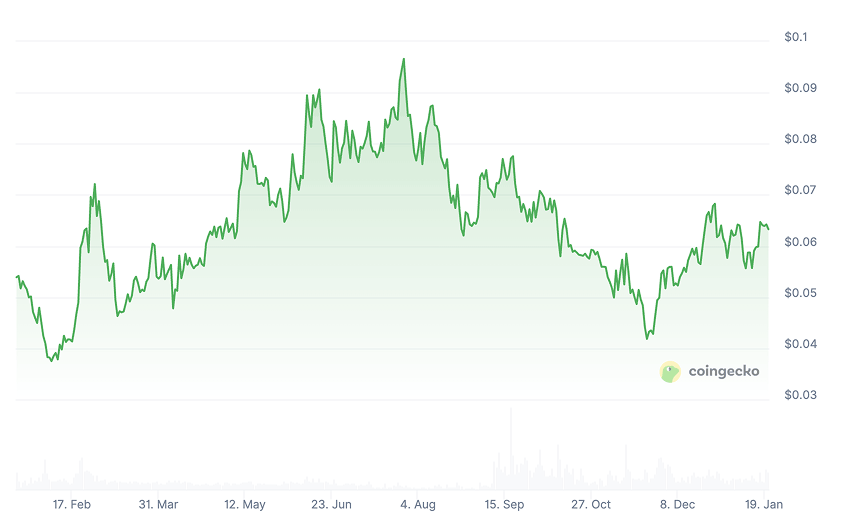
CoinGecko, January 20, 2026
2017 – The Early Days of MakerDAO’s MKR
MakerDAO’s MKR token launched in August 2017, starting in the low single digits. As crypto markets heated up, interest in decentralized finance slowly grew. By November, MKR had climbed toward $30. The year closed around $40, marking the project as a small but promising player in the new DeFi landscape.
2018 – Boom and Crash
January 2018 saw MKR peak near $900, fueled by the ICO boom. However, the bear market that followed hit hard. By December, the token had collapsed below $200. This dramatic cycle mirrored the broader crypto crash, testing the resilience of both the token and its community.
2019 – Slow Recovery
The following year brought a quieter phase. MKR traded mostly between $300 and $700, supported by the gradual adoption of DeFi tools. While no explosive growth occurred, the steady interest showed the protocol had staying power beyond speculative hype.
2020 – The DeFi Summer Surge
In 2020, DeFi captured mainstream attention. MKR rose from about $500 in January to $1,400 in August. By the end of the year, profit-taking saw it fall back near $700. Still, the surge proved MakerDAO’s position at the heart of decentralized finance.
2021 – Record-Breaking Rally
May 2021 was MKR’s peak moment, hitting nearly $6,300. It became one of the most valuable governance tokens in the market. But the hype cooled quickly. By December, it had retraced to the $2,000–$3,000 range, reflecting broader volatility in DeFi assets.
2022 – Turbulence and Uncertainty
The global downturn and on-chain crises shook investor confidence. MKR traded between $600 and $1,600 during the year, finally closing near $900. This range highlighted how DeFi tokens could suffer during both macroeconomic and industry-specific shocks.
2023 – Post-Crisis Struggles
After the collapse of FTX and Alameda, MKR slipped further, hovering mostly in the $600–$800 zone. Occasional rebounds above $1,000 did occur, but pressure from a cautious market environment kept gains limited.
2024 – Modest Rebound
A mild DeFi revival lifted MKR to $1,200 mid-year. However, profit-taking dragged it back down, ending the year near $800. While modest, this signaled resilience compared to weaker altcoins.
2025 – Endgame Transition and Pullback
By September 2025, MakerDAO prepared for the full rebrand into Sky. MKR rallied to about $2,200 on September 17, just before the migration to SKY began.
On September 18, SKY debuted at $0.09 following the 1 MKR = 24,000 SKY conversion. Over the next few month, it pulled back to around $0.07.
2026 – New Achievements and New Heights
At the beginning of 2026, the coin price fluctuates between $0.55 and $0.65 with a slight upward trend.
Sky Price Prediction: 2026, 2027, 2030–2040
| Year | Minimum Price | Maximum Price | Average Price | Price Change |
| 2026 | $0.08 | $0.11 | $0.1 | +60% |
| 2027 | $0.11 | $0.15 | $0.13 | +105% |
| 2030 | $0.3 | $0.43 | $0.35 | +450% |
| 2040 | $36 | $43.4 | $40 | +63,000% |
| 2050 | $53 | $61.4 | $55 | +97,000% |
Sky Price Prediction 2026
DigitalCoinPrice expects Sky to move higher in 2026. Their forecast places SKY between $0.0811 (+35%) and $0.11 (+80%), which suggests a moderate but steady recovery phase after accumulation.
PricePrediction.net is slightly more conservative. Their models show a minimum of $0.0806 (+30%) and a maximum of $0.0994 (+65%), pointing to a year of gradual growth rather than explosive moves.
Sky Price Prediction 2027
DigitalCoinPrice sees continuation of the uptrend in 2027. According to their estimates, SKY could trade between $0.11 (+80%) and $0.15 (+150%), driven by broader adoption and improving market conditions.
PricePrediction.net aligns closely with this outlook. Their 2027 forecast sets a floor at $0.1173 (+95%) and a ceiling at $0.1396 (+130%), which confirms expectations of stable but healthy expansion.
Sky Price Prediction 2030
By 2030, DigitalCoinPrice becomes clearly more bullish. Their models suggest Sky could trade between $0.29 (+380%) and $0.37 (+510%), assuming long-term growth of the ecosystem and wider market maturity.
PricePrediction.net is even more optimistic. Their projection for 2030 places SKY between $0.3572 (+480%) and $0.4316 (+610%), indicating that Sky could be several times higher than today if development and adoption continue.
Sky Price Prediction 2040
PricePrediction.net’s long-term scenario for 2040 is extremely aggressive. According to their forecast, Sky could trade between $35.81 (+56,500%) and $43.42 (+68,500%), assuming massive global adoption and a very favorable macro environment for crypto assets.
This implies a shift from a small-cap asset into a large-scale digital asset over the next 15 years.
Sky Price Prediction 2050
Looking even further ahead, PricePrediction.net estimates that by 2050 Sky could reach between $52.93 (+83,500%) and $61.41 (+97,000%). This scenario assumes Sky becomes a mature, widely used blockchain asset within a much larger crypto economy.
Sky Price Prediction: What Do Experts Say?
When experts discuss Sky’s price outlook, they focus less on hype and more on risk, structure, and cash flow. The most serious opinion came in August 2025. S&P Global Ratings gave Sky Protocol a B-minus credit rating with a stable outlook. This does not predict the token price. However, it shows how institutions see Sky’s financial strength and governance. A B-minus sits deep in speculative territory. It places Sky next to high-risk sovereign debt.
S&P sees two sides of the story. On one hand, the protocol shows low credit losses since 2020, solid liquidity reserves, and audited smart contracts. On the other hand, the agency points to major weaknesses. Deposits come from a small group of users. Governance stays in transition. Capital buffers look thin. The most worrying part involves control. Rune Christensen holds only 9% of governance tokens. Yet, low voter turnout gives him effective control. S&P says any upgrade needs better decentralization, stronger capital, and more diverse depositors. As of January 2026, these points remain open.
Other experts raised similar concerns. In December 2025, Aave voted to delist Sky’s USDS stablecoin. The reason was a changing risk profile of the collateral. This vote sent a strong signal. Even major DeFi players now question Sky’s risk management. Reports from Galaxy Digital and Blockworks went further. They criticized the stUSDS product, which offers yields up to 40% and uses SKY as collateral. The protocol even subsidizes rates above 20%. This approach looks aggressive and risky. Analysts also noted manual rate setting and disabled liquidations. These choices hurt long-term trust.
Still, not every expert stays bearish. AInvest News published a bullish report in late 2025. It highlighted Sky’s $96 million buyback program, which already removed 5.5% of the supply. The protocol also posted $435 million in annualized revenue and $168 million in profits. Few DeFi projects show numbers like this. The buybacks create a clear deflationary effect. SKY even rose 2% while most altcoins fell.
SKY USDT Price Technical Analysis
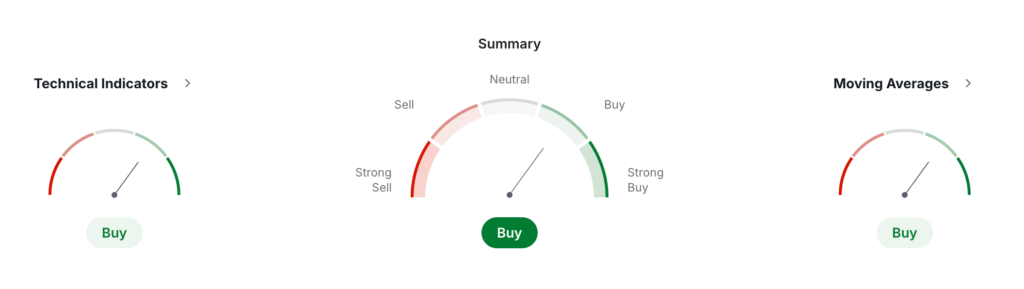
This technical analysis uses monthly data from Investing.com and reflects the latest market structure of SKY. At the moment, the overall signal is Neutral. The market shows mixed signs, and neither buyers nor sellers control the trend.
Investing, January 20, 2026
Let’s start with the general picture. The summary stands at Neutral. Moving averages also show a Neutral signal, with six buy and six sell indications. Technical indicators lean slightly positive, but they do not confirm a clear trend yet. This kind of setup often appears during consolidation phases.
Momentum indicators send conflicting messages. RSI stands at 100, which means the asset is in an overbought zone. This level often appears after a strong move. At the same time, both Stochastic and Stoch RSI show oversold values near zero. This rare combination signals unstable momentum and possible sharp moves in both directions.
MACD still gives a buy signal. This suggests that some upside pressure remains. However, ADX stays near 20, which means the trend lacks strength. In simple words, the market moves, but it does not follow a clear direction yet. Williams %R and the Highs/Lows indicator both support a short-term bullish bias. On the other hand, the Ultimate Oscillator shows a sell signal. ROC stays neutral and confirms the lack of momentum structure.
Volatility is rising. ATR points to high volatility, which means price swings can become wider and faster. This environment often brings false breakouts and sudden reversals. Traders should expect unstable price action.
The moving averages confirm the buying trend. All simple short-term values from MA5 to MA10 continue to show buy signals. However, the long-term values show mixed signals. This division explains why the final conclusion based on the moving averages remains a buy. The short-term and long-term signals are not yet aligned.
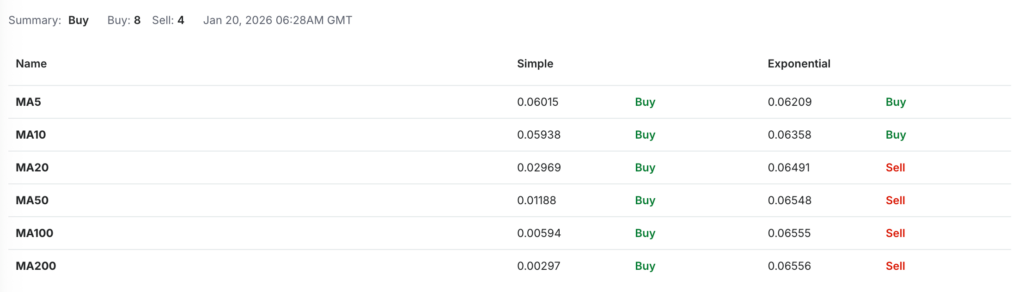
Pivot points define key technical levels. The main pivot sits near 0.0585. The closest support zone stands around 0.05–0.047. Below that, stronger support appears near 0.037 and 0.026. On the upside, resistance levels sit near 0.066, 0.071, and 0.079.
In summary, SKY USDT stays in a transition phase. The trend lacks direction. Volatility rises. A clear breakout above resistance or a drop below support will likely decide the next major move. Until then, the technical outlook remains neutral and cautious.
What Does the Sky Price Depend On?
The price of Sky (SKY) is shaped by several interconnected factors that influence both its short-term movements and long-term potential. As a governance token born from MakerDAO’s transition, its value reflects not only speculative demand but also the strength of the ecosystem it powers.
One of the most direct drivers is market demand for USDS, the stablecoin connected to the Sky Protocol. Since USDS is minted and burned depending on loan activity, demand for borrowing and saving directly impacts how much SKY is used in governance and liquidity. Higher adoption of USDS typically translates into stronger utility for SKY.
Investor confidence plays a central role as well. When figures like Rune Christensen actively buy back SKY, it signals trust from leadership and can inspire broader market optimism. Similarly, institutional perspectives on Sky as a long-term DeFi infrastructure project may attract larger pools of capital.
The state of the wider crypto market also matters. In bullish environments, governance tokens often receive more attention and capital inflows. In bearish cycles, they tend to lose value as investors rotate into stablecoins or major assets like Bitcoin and Ethereum.
Other important factors include:
- Governance outcomes: Community votes on collateral types, interest rates, and new modules can directly affect token demand.
- Ecosystem growth: Expansion of projects like Sky Stars or integrations via SkyLink can increase usage.
- Liquidity availability: Open liquidity pools determine how easily users can trade or stake, influencing token circulation.
- Regulatory stance: Built-in compliance tools could help Sky expand in certain regions, but restrictions may also limit adoption in others.
Finally, technical signals such as moving averages and RSI values guide traders’ short-term decisions, amplifying volatility during key moments. Taken together, SKY’s price is not determined by a single factor but by the balance between protocol fundamentals, governance activity, market sentiment, and external conditions.
Sky (SKY) Price Prediction: Questions and Answers
Is Sky Coin a Good Investment?
Sky can be seen as a high-risk, high-reward investment. It emerged from the MakerDAO rebrand, which gives it strong DeFi roots. However, its short trading history makes it unpredictable. The future will depend on USDS adoption, ecosystem expansion, and governance activity. For those exploring innovative DeFi, it may offer opportunities, but it is not a guaranteed safe choice.
Is Sky Money Safe?
Sky.money is non-custodial, meaning users always keep control of their private keys. This setup reduces custodial risks compared to centralized exchanges. Still, risks such as smart contract bugs or governance missteps remain. While the system builds on MakerDAO’s trusted foundation, no DeFi protocol is entirely free from risk.
What Is the SKY Coin Prediction?
Forecasts differ significantly. Some analysts expect the price to remain close to current levels, while others see growth potential by 2030 if adoption rises. Projections range from cautious consolidation in 2026 to possible gains above $0.4 in the longer term.
Will SKY Coin Reach $0.1?
Hitting $0.1 is possible, but not assured. Current short-term predictions keep Sky below that level. However, with stronger momentum and rising adoption of USDS, Sky could eventually test the $0.1 mark. Governance participation will be a key factor.
Will SKY Reach $0.5?
Reaching $0.5 would require a significant leap beyond current forecasts. Such growth depends on massive ecosystem adoption and sustained DeFi expansion. While the scenario cannot be ruled out, it is more of a long-term stretch than a near-term expectation.
Can SKY Coin Reach $1?
A price of $1 would mean extraordinary growth from today’s levels. For this to happen, Sky would need to become a dominant governance token in DeFi, rivaling major protocols. At present, this goal is considered distant and unlikely in the near future.
How to Use SKY Coins?
SKY tokens are primarily designed for governance. Holders can vote on collateral, interest rates, and system upgrades. They can also stake tokens for rewards or use them as collateral to borrow USDS. Beyond trading, their value lies in shaping the protocol and earning incentives.
Where to Buy SKY Coins?
StealthEX is here to help you buy SKY coin if you’re looking for a way to invest in this cryptocurrency. You can buy SKY safely and without the need to sign up for the service. StealthEX crypto collection has more than 2,000 different coins, and you can do wallet-to-wallet transfers instantly and problem-free.
How to Buy SKY Coin? Quick-Step Guide
Just go to StealthEX and follow these easy steps:
- Choose the pair and the amount you want to exchange — for instance, ETH to SKY.
- Press the “Start exchange” button.
- Provide the recipient address to transfer your crypto to.
- Process the transaction.
- Receive your crypto coins.

Follow us on Medium, X, Telegram, YouTube, and Publish0x to stay updated about the latest news on StealthEX.io and the rest of the crypto world.
Don’t forget to do your own research before buying any crypto. The views and opinions expressed in this article are solely those of the author.
crypto price prediction Ethereum MakerDAO price prediction SKYRecent Articles on Cryptocurrency

 What Will Ethereum Be Worth By End of 2026?