Is Bitcoin Cryptocurrency? The Simple Difference

Yes, Bitcoin is a cryptocurrency. It is one asset with the ticker BTC, while crypto is the word for the whole group of coins and tokens recorded on blockchains. An altcoin is any cryptocurrency that is not Bitcoin, such as Ether, SOL, or XRP. All three words describe assets you can hold in one wallet app, and each coin has its own ticker and network.
If you are new to crypto and use Bitcoin and crypto as if they meant the same thing, three short definitions sort it out. The mix-up has a simple cause: Bitcoin came first, in January 2009, so its name often stands in for the whole group. A news line says “crypto fell” when it means most coins, and a friend says “I bought Bitcoin” when the coin was really ETH. For the mechanics behind the coins, read how cryptocurrency works. To compare individual coins, open the altcoin guide.
StealthEX is a non-custodial exchange for wallet-to-wallet swaps, and a standard crypto-to-crypto swap needs no account. Verification may be requested if a wallet or transaction is flagged. Get the three words straight before your first swap: a Bitcoin address that starts with bc1 cannot receive ETH, and coins sent to the wrong network may not come back.
Article contents
Yes. Bitcoin Is One Cryptocurrency
Is Bitcoin a cryptocurrency or the whole market? It is a single asset, and its ticker is BTC. It runs on its own network, the Bitcoin blockchain, where every BTC transfer is recorded. Bitcoin is not a second name for every cryptocurrency. Its supply is capped at 21 million BTC, and the smallest unit, one satoshi, is 0.00000001 BTC. A wallet line that says BTC holds Bitcoin only, while a line that says total crypto can add up several different coins.
What the Beginner Should Picture
Think of crypto as a box of coins. Bitcoin is one coin in that box. Ether, SOL, LTC and XRP are other coins in the same box, sitting next to Bitcoin rather than inside it. Every coin in the box is a cryptocurrency, Bitcoin included. The box also holds coins far smaller than Bitcoin, and stablecoins such as USDT that aim to stay at $1. Size does not change the rule: a big coin is still one coin, and a small one is still a cryptocurrency.
When you hold Bitcoin, you hold one coin from the box, not the whole box. When you hold Ether, you hold a different coin from the same box. The box itself is not a coin, so it has no ticker and no price of its own. Taking one coin out of the box to send it leaves every other coin where it was.
A friend who says “I bought crypto” has told you they took something from the box, but not which coin. A friend who says “I bought Bitcoin” has named the coin.
Crypto Is the Category, Not a Rival Coin
Crypto is short for cryptocurrency. Both words are the same wide label for coins and tokens recorded on blockchains, and neither word is a ticker. No exchange lists a coin called crypto that trades against Bitcoin, so a crypto vs Bitcoin chart does not exist the way a BTC to ETH chart does.
A headline that puts Bitcoin vs crypto side by side compares one asset with the category it belongs to, not two coins. “Crypto fell today” usually means most coins lost value that day. “Bitcoin fell today” names BTC only.
The same rule works in an exchange menu. Searching Bitcoin or BTC finds that asset, and searching Ethereum or ETH finds Ether. Typing crypto does not choose any coin, because a trading pair always needs two named assets, such as BTC and ETH.
Crypto news uses the word the same way. A report that crypto lost value in a week describes many coins at once, often led by Bitcoin and Ether. To know what happened to your own money, look up the ticker you actually hold.
The Difference in One Sentence
Crypto is the category, and Bitcoin is one cryptocurrency inside it.
That is the whole difference between Bitcoin and cryptocurrency. Every Bitcoin is crypto, but not every crypto is Bitcoin.
So what is the difference between Bitcoin and crypto in daily use? It is the level of detail. If a form asks what type of asset you hold, cryptocurrency is the category answer. If it asks which coin you hold, Bitcoin or BTC is the specific answer. If your wallet shows that you received ETH, calling it crypto is correct, and calling it Bitcoin is wrong. Price sites follow the same split: a BTC page shows one coin, and a market overview shows the whole category.
The sentence also works in reverse. “I own crypto” is always true for someone who holds BTC. “I own Bitcoin” is true only for someone who holds BTC, not for someone who holds only ETH or SOL.
Three Mix-ups to Untangle
“Crypto” is not a coin named Crypto. Price apps list coins by tickers such as BTC, ETH or SOL, and the word crypto names the whole list. A total labeled crypto in an app is a sum of separate coins.
“Bitcoin” is not the name of every cryptocurrency. Sending ETH to a friend is sending crypto, but not Bitcoin, and a BTC address cannot receive it. A BTC price chart tracks Bitcoin alone.
An altcoin is not something outside crypto. Ether, SOL, LTC and XRP are cryptocurrencies too, just not Bitcoin. Stablecoins such as USDT are inside crypto as well, and each has its own ticker.
| Question | Crypto | Bitcoin | Altcoin |
|---|---|---|---|
| What it is | The whole category | One cryptocurrency | Any cryptocurrency that is not Bitcoin |
| Is it a ticker? | No, it is not one coin | Yes, BTC | Each has its own, such as ETH or SOL |
| How they relate | Contains Bitcoin and the altcoins | Inside crypto | Inside crypto, and not Bitcoin |
Altcoins Are the Other Cryptocurrencies
An altcoin, short for alternative coin, is any cryptocurrency other than Bitcoin. Ether, Solana’s SOL, Litecoin and XRP are common examples, named here in no particular order and not as picks to buy. Litecoin, launched in October 2011, was one of the early altcoins.
Each altcoin follows its own rules. Litecoin has an 84 million coin limit, XRP has a fixed supply of 100 billion, and SOL has no hard cap. Bitcoin’s limit is 21 million. Owning one of these coins does not give you units of any other.
A Bitcoin vs altcoins question compares one coin with every other coin, and Bitcoin vs other crypto is the same question in different words. Stablecoins such as USDT count as altcoins in this broad sense, even though they aim to track the US dollar. Altcoins also include tokens that run on another coin’s network, such as USDT on Ethereum or TRON. The altcoin guide covers individual coins in depth.
Ethereum Is Another Cryptocurrency
Ethereum is not Bitcoin, and it is not a newer name for it. Ethereum is a separate network, and its coin is Ether, with the ticker ETH. Many apps label the coin Ethereum as well. Ethereum launched in July 2015 and runs smart contracts, small programs that apps use for lending or trading. Ether is the coin that pays fees on the Ethereum network.
Because Ether is a cryptocurrency that is not BTC, it is an altcoin in the broad use of the word. In an altcoin vs Bitcoin question, Ether sits on the altcoin side, and that label says nothing about which coin is better.
A Beginner Example
Anna buys 0.01 BTC and 0.2 ETH. She now holds two cryptocurrencies, so everything she holds is crypto. Only the 0.01 BTC is Bitcoin. The 0.2 ETH is an altcoin.
Her wallet app may show both coins under one Crypto tab. That tab is a label that groups the two coins; it is not a third coin. Inside the tab, BTC and ETH appear as two separate lines, each with its own ticker and price.
If Anna tells a friend she owns crypto, she is right. If she says she owns only Bitcoin, she is wrong, because the Ether is a separate cryptocurrency on a different network. Her BTC address starts with bc1 and her ETH address starts with 0x, another sign of two separate coins. The two coins also have different supply rules: Bitcoin is capped at 21 million, and Ether has no fixed maximum. The app’s dollar total adds both lines together, but the coins themselves never merge.
What These Definitions Will Not Decide
The three words do not pick a coin for you to buy. They do not forecast a price, and they do not compare Bitcoin ETFs or any other fund. They also do not tell you when to buy or sell. The word altcoin does not mean cheap, new or likely to beat Bitcoin. It only means the coin is not BTC.
Whether a coin suits you depends on things the words do not cover, such as how much price movement you can accept and how long you plan to hold. The labels stay the same whether you hold Bitcoin alone, an altcoin alone or no cryptocurrency at all.
If you only needed the words separated, you can stop here. To compare individual coins, open the altcoin guide.
Where to Swap Bitcoin and an Altcoin
StealthEX is a non-custodial, wallet-to-wallet exchange. You send one coin from your wallet and receive the other coin in a wallet you choose. A standard crypto-to-crypto swap does not require registration. Verification may be requested if a wallet or transaction is flagged. The recipient address is the wallet where the new coins land, so it must belong to the coin you receive.
You can pick a fixed rate or a floating rate. A fixed rate locks the quote when you send the deposit within the order’s conditions. A floating rate moves with the market while the swap is processed, so the payout can end higher or lower than the first estimate. Both rate types show an estimate before you create the order.
The estimate already includes the network fee and the liquidity provider fee. You still pay the fee of the network you send from, for example the Bitcoin network fee when you send BTC. StealthEX does not set that fee; it depends on how busy the Bitcoin network is when you send. The swap steps show each screen of an order.
On November 19, 2026, a quote for 0.01 BTC showed about 8.481953 SOL. The amount changes with the market and the rate type you pick.
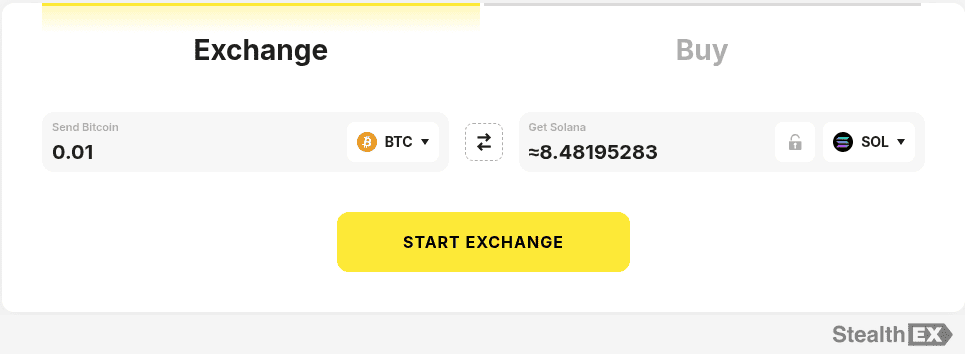
BTC to SOL swap estimate. Source: StealthEX
Pages to Open
Start from the Bitcoin page or the page of the altcoin you want, then pick one pair. StealthEX lists more coins than these pages, and the live widget shows whether your pair is available today.
| Page | Link | How to Use It |
|---|---|---|
| Bitcoin | stealthex.io/coin/bitcoin | The Bitcoin exchange page |
| Ethereum | stealthex.io/coin/ethereum | Altcoin example |
| Solana | stealthex.io/coin/solana | Altcoin example |
| Litecoin | stealthex.io/coin/litecoin | Altcoin example |
| XRP | stealthex.io/coin/xrp | Altcoin example |
| Tether | stealthex.io/coin/tether | USDT, with a network label |
| BTC to ETH | Bitcoin to Ethereum | Example pair |
| ETH to BTC | Ethereum to Bitcoin | Example pair |
| BTC to SOL | Bitcoin to Solana | Example pair |
| BTC to USDT | Bitcoin to Tether | Example pair |
What You Do
First, choose the pair and the amount, for example BTC to ETH. Second, choose a fixed or a floating rate. Third, enter the recipient address for the coin you will receive. Add a memo or Extra ID when the asset needs one, such as the destination tag an exchange gives for an XRP deposit, and copy it from the receiving platform rather than guessing.
Next, send the deposit to the address the order shows, in the amount shown. The service makes the swap, and the new coins arrive in the wallet you entered. Send from a wallet that holds enough of the sending coin to pay its network fee. If the deposit amount differs from the order, a fixed-rate quote may no longer apply.
Save the order ID and both transaction hashes until the coins arrive. The deposit hash shows the coins you sent, and the payout hash shows the coins sent to you. StealthEX does not keep the coins after the swap and cannot reverse a completed swap, so check the recipient address before you confirm the order.
The Network Still Has to Match
Bitcoin and an altcoin are different assets on different networks. The receiving wallet must be on the same network as the coin you receive. A Bitcoin address does not automatically receive every other coin: one that starts with bc1 does not receive Ether. A wrong-network deposit is not a normal transfer, and StealthEX cannot promise to recover it.
| Check | What to Confirm | Do Not Assume |
|---|---|---|
| Words | You can tell crypto, Bitcoin and an altcoin apart | That crypto and Bitcoin are two tickers |
| Pair | The live widget offers the pair | That a coin page means every pair is available |
| Network | The receiving wallet is on that coin’s network | That a Bitcoin address can receive every altcoin |
| Account | No registration for a standard crypto-to-crypto swap | That verification is never requested |
| After the swap | The coins are in your recipient wallet | That StealthEX holds your balance |
Frequently Asked Questions
Is Crypto a Ticker That Trades Against Bitcoin?
No. Crypto is the category, and there is no single coin that the word crypto always means. Bitcoin is one cryptocurrency inside that category, with the ticker BTC. Every trading pair names two assets, such as BTC and ETH, so no order can buy crypto as such. An app’s crypto total is a sum of named coins, not a price for the word.
Is Ethereum Just Another Name for Bitcoin?
No. Ethereum is a different network, and its coin, Ether (ETH), is a different cryptocurrency from Bitcoin. In the broad use of the word, that makes Ether an altcoin. A wallet that holds both shows two separate balances, each with its own ticker. Ether also uses its own address format, starting with 0x, while Bitcoin addresses often start with bc1.
Does a StealthEX Swap Need an Account?
A standard crypto-to-crypto swap does not require registration, so there is no sign-up step. Verification may be requested if a wallet or transaction is flagged. For a normal order, you choose the pair, enter the recipient address and send the deposit shown on the order. No password or profile is created along the way.
Does StealthEX Keep Bitcoin After the Swap?
No. After a completed swap, the coins are in the recipient wallet you entered. StealthEX does not hold them in an account and cannot reverse the swap. To move the coins again, you send them from that wallet yourself, paying that network’s own fee. Keep the order ID and both hashes as your record of the swap.
Will These Definitions Say Whether Bitcoin or an Altcoin Will Rise?
No. They only separate the words: Bitcoin is one cryptocurrency, crypto is the category, and an altcoin is any other coin. None of these labels contains a forecast, a target price or a ranking of which coin to buy. Knowing that Bitcoin is one cryptocurrency says nothing about how its price will move against altcoins.
Conclusion
Bitcoin is a cryptocurrency, and its ticker is BTC. Crypto is the category that holds every cryptocurrency. Altcoins are the other cryptocurrencies, from Ether and SOL to stablecoins such as USDT. All three words describe assets you can hold, send and swap, and none of them is a coin named crypto. Bitcoin has its own network and address format, and so does each altcoin. Use the three words that way, and you will also know which coin you hold and which network its address belongs to.
When you are ready to exchange one coin for another, start a swap on StealthEX with no registration after the widget shows your pair. Open the Bitcoin page or the Ethereum page, follow the swap steps, or compare other coins in the altcoin guide.
Don’t forget to do your own research before buying any crypto. The views and opinions expressed in this article are solely those of the author.
Recent Articles on Cryptocurrency