CeFi: How It Compares With DeFi and a Non-Custodial Exchange

What is CeFi? It is crypto with a company in the middle. An exchange account is the familiar example: you deposit coins, trade an account balance and ask the company to release a withdrawal. DeFi instead lets you use a protocol from your own wallet, as the DeFi guide explains. A non-custodial exchange is a third setup: a wallet-to-wallet swap, not an account and not a protocol you operate.
The three setups differ in who holds your coins, what you open and what can go wrong. StealthEX is a non-custodial exchange of that third kind. A standard crypto-to-crypto swap needs no account, and the completed swap ends in your recipient wallet. Verification may be requested if a wallet or transaction is flagged. For CeFi crypto, the difference showed on June 12, 2022, when Celsius paused all withdrawals and customers could not move the coins their accounts still showed.
Article contents
What Is CeFi?
What is centralized finance? It is crypto where a company holds your coins or stands between you and the trade, and CeFi is its short name. It is a service model, not a coin or a blockchain. That is the CeFi meaning in one line: a company runs the service, and you trust it with the coins. Your account balance depends on the company’s records and its ability to honor a withdrawal, not just on a transaction visible on a public network.
The Company Sits in the Middle
A CeFi platform normally gives you a company account, a password, a balance and a support desk. The company controls the wallets used to hold customer deposits. It can set withdrawal limits, request documents, suspend an account or restrict a supported asset. Knowing your login does not give you the private keys to those wallets. The company is your counterparty: what you get back depends on it.
The distinction shows up when an account says you own 1 ETH. That number is a claim recorded by the company; it is not necessarily 1 ETH held at a separate blockchain address in your name. The company may combine many customer balances in shared wallets and move coins between hot and cold storage.
There is no special CeFi blockchain: the networks a service lists are simply the ones it accepts. A support agent can fix an account problem, but a ticket cannot reverse a finalized blockchain transaction.
An Exchange Account Is the Common Example
What is a centralized exchange in practice? A centralized crypto exchange gives you a deposit address it controls. After enough confirmations, it credits your account. You then trade an internal balance on the platform’s order book, with no onchain transfer for each single trade.
To leave, you choose an asset, a supported withdrawal network and a destination address. The company checks the request against its rules, then sends from one of its wallets. A market can stay open while withdrawals on one network are paused.
CeFi also includes custodial wallets and company-run lending. The shared feature is not a particular trading screen; it is a company holding the assets or running the account.
On November 19, 2026, DefiLlama tracked $216.9 billion in public exchange wallets. These are tracked assets, not an audit of each company’s debts.
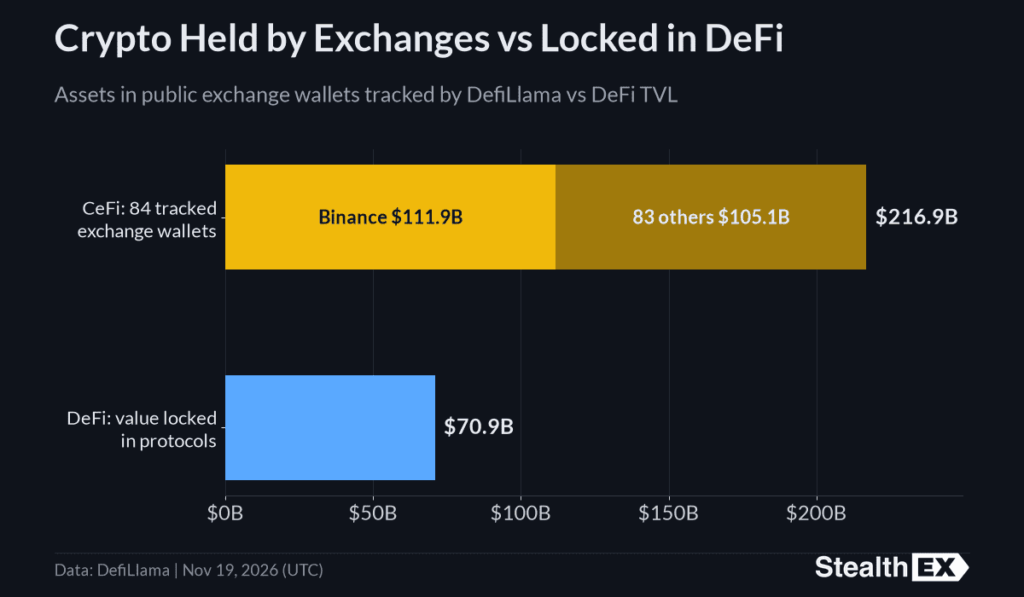
Tracked exchange assets and DeFi value locked. Source: DefiLlama
CeFi vs DeFi
In CeFi vs DeFi, the main difference is who runs the transaction and where the position sits. With CeFi, you use an account maintained by a company. With DeFi, you send transactions from a wallet to contracts such as lending pools and DEXs. Neither model is always safer, and DeFi vs CeFi is a choice about who holds the coins and who you rely on.
Custody vs a Wallet You Control
Custodial vs non-custodial comes down to who can move the coins. A custodial service controls the keys to its deposit wallets, so the company can move them, and you control only an account subject to its terms. In a self-custody wallet, you control the keys that sign transactions. A DeFi deposit then moves assets into a contract, which applies the protocol’s rules rather than leaving the deposit as spendable coins in your wallet.
For example, lending USDC through a protocol can leave you with a position or receipt token. You still sign with your wallet, but withdrawing depends on the contract, available liquidity and the state of that position. Holding the keys does not remove contract risk. An unsafe approval can also let a contract spend tokens you did not intend to lend.
In CeFi and DeFi alike, a non-custodial wallet is not the same thing as a non-custodial exchange: the wallet stores your keys, and the exchange performs a swap. Keep the seed phrase separate from a public address and use the wallet security checks before signing transactions.
What You Actually Do
In centralized vs decentralized crypto, the first step already differs. CeFi usually begins with registration and identity checks. You deposit to the company’s address and later request withdrawals through its account controls. With DeFi, you normally connect a wallet, check a transaction or approval, and pay the relevant network fee when you sign.
A site in front of a protocol can still block a region or screen a wallet address, so no account does not mean unrestricted use. The DeFi vs CeFi differences are real: one is a company account, the other is a smart contract you call yourself.
| Question | CeFi | DeFi | Non-Custodial Exchange |
|---|---|---|---|
| Who runs it | A company | A protocol you use | An instant exchange, no pool to run |
| Where the coins sit | On company books | In your wallet or a contract | In your wallets, except during the swap |
| What you open | An account, usually on an exchange | A wallet connection | A swap, no account for a standard swap |
| What can go wrong | A freeze, insolvency or a refused withdrawal | A contract, approval or pool fails | A wrong address, a wrong network or a finished swap |
Lending Does Not Make Them the Same
CeFi lending places the company between depositor and borrower. Your risk includes its solvency, lending decisions and withdrawal terms. DeFi lending uses a contract to track deposits, debt and collateral. The risks move to code, price feeds, liquidity and liquidation rules rather than disappearing.
In DeFi vs CeFi lending, a displayed yield is not guaranteed. A protocol rate can fall with borrowing demand, and a company can change its advertised rate under its own account terms.
Galaxy Research counted $22.98 billion in CeFi crypto-backed loans and $20.43 billion on DeFi lending apps on June 30, 2026, the first time since Q3 2023 that CeFi led. Tether alone held 58.54% of tracked CeFi lending.
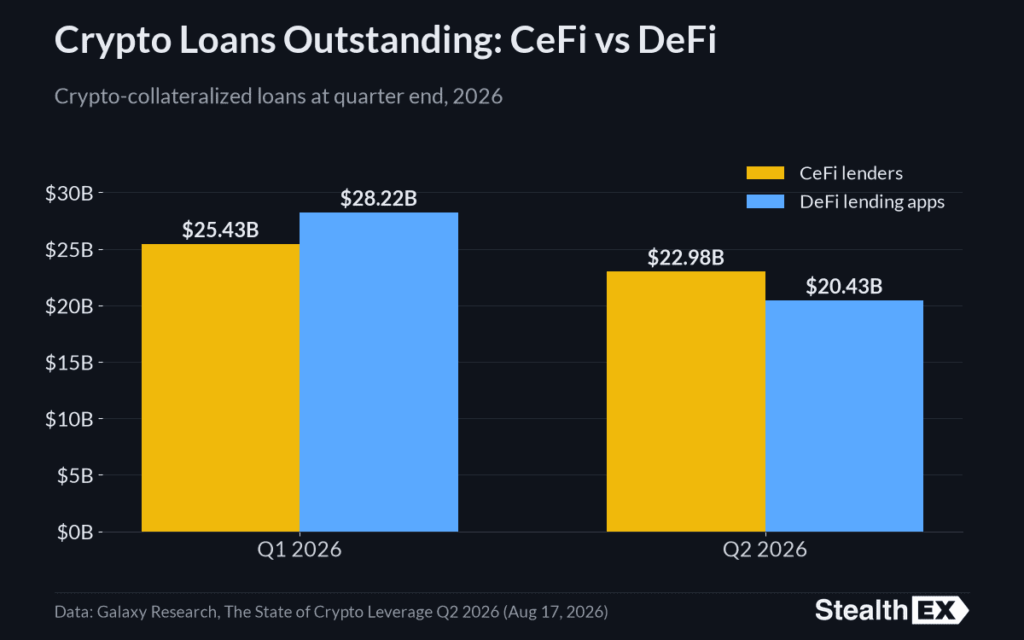
CeFi vs DeFi crypto loans, Q2 2026. Source: Galaxy Research
A Non-Custodial Exchange Is the Third Option
A non-custodial exchange is not CeFi, because you do not leave an account balance with the company. It is not DeFi either, because you do not operate a pool or a protocol position. StealthEX is this third model: you send a deposit for one order and receive the new coins in a wallet you choose. It is an exchange service, not a smart-contract DEX that you run from a wallet connection, and it handles your coins only while the swap is processed.
What Happens on a Wallet-to-Wallet Swap
Unlike a centralized vs decentralized exchange choice, this is one swap. Choose a pair and amount, then check the estimate. A fixed rate locks the quote subject to the order’s deposit conditions; a floating rate can change with the market while the exchange is processed. Select the rate before creating the order, and do not treat the first estimate as a final payout.
Enter the recipient address, including a memo or Extra ID if required. Send the specified deposit to the order’s deposit address, not to the recipient address. The service processes the swap and pays the output to your wallet. A standard crypto-to-crypto order requires no registration, although verification may be requested if the wallet or transaction is flagged.
The estimate includes the network fee and the liquidity provider fee. You still pay your source network’s fee to send the deposit. After completion, StealthEX does not keep the coins and cannot reverse the swap. The product instructions show each screen of the order.
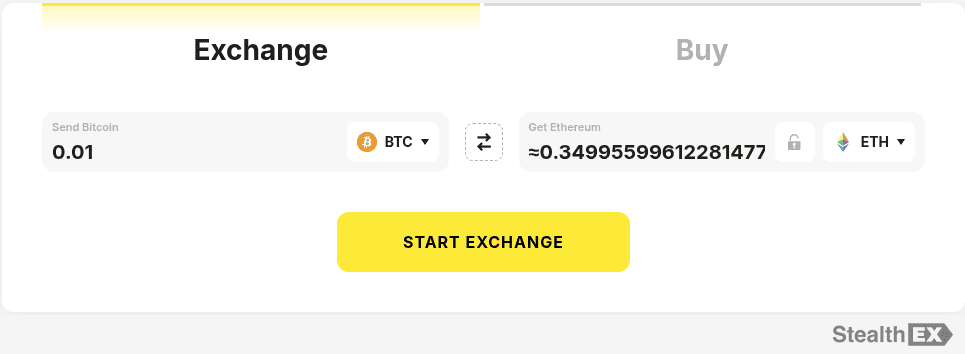
BTC to ETH swap estimate. Source: StealthEX
On November 19, 2026, the widget offered BTC to ETH, and a quote for 0.01 BTC showed about 0.349956 ETH. That is a live estimate, not an account balance or a rate saved for later orders. The lock icon next to the amount you get switches between the fixed and floating rate.
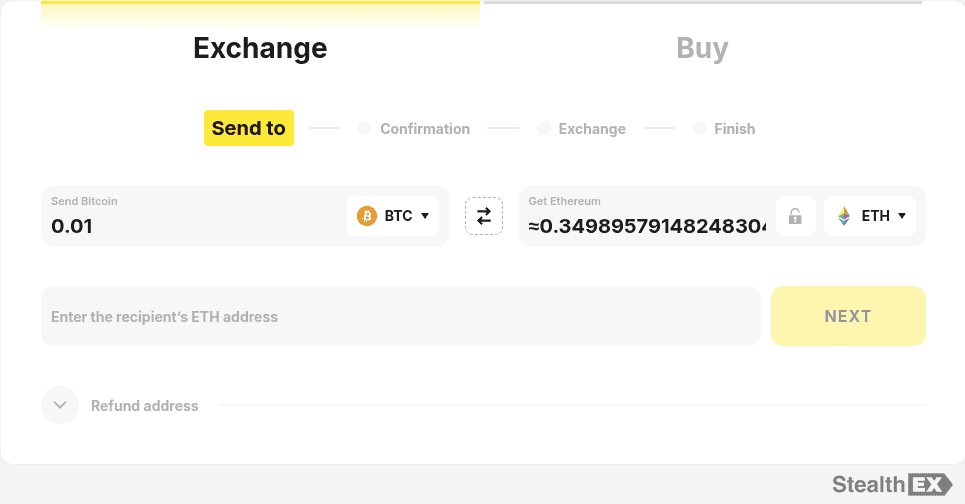
ETH recipient field for a wallet-to-wallet swap. Source: StealthEX
Leaving a CeFi Balance Is Not the Same as Using DeFi
Moving from CeFi to DeFi takes separate steps. Withdrawing ETH from an exchange to your own wallet changes who controls the keys. It does not automatically open a lending position or place the coins in a liquidity pool; they simply sit in your wallet.
Using DeFi is a later action: you choose a protocol and sign its transactions. Making a wallet-to-wallet swap is another separate action: you fund an order and receive the output. The ticker can stay the same while the custody and transaction route change.
Match the withdrawal network to the destination before leaving the CeFi service. ETH on Ethereum and ETH on Base are separate balances, even if your wallet uses the same address on both. A withdrawal on the wrong network is not a normal transfer, and neither the exchange nor StealthEX can promise to recover it.
Where the Risk Sits
For CeFi, the company can freeze access or fail to repay a balance, as Celsius did when it paused all withdrawals on June 12, 2022. For DeFi, a contract, approval or pool can fail while you still hold your keys. For a non-custodial swap, the immediate checks are the recipient address, the two networks and the order conditions: a finished swap cannot simply be undone.
| Check | What to Confirm | Do Not Assume |
|---|---|---|
| Job | Hold coins on an account, use a protocol or swap wallet to wallet | That the three names are one product |
| Freeze | Who can stop the coins | That a finished non-custodial swap can freeze a balance it no longer holds |
| Yield | Any rate is dated and comes from that platform’s page | That a CeFi or DeFi yield is guaranteed |
| Widget | The live StealthEX widget offers the pair | That every coin can be swapped |
How to Choose Among the Three
Choose an exchange account when you want a company to hold a trading balance for you and run the trades on its own order book. Exchanges also differ in withdrawal fees, limits and supported networks.
Choose DeFi when the job requires a protocol position, such as lending from a wallet or supplying pool liquidity.
Choose a non-custodial exchange when you want to swap from one wallet to another and not leave the coins on an account. That last job is the one StealthEX does. Start a swap with no registration, after the widget confirms the pair, and follow the deposit instructions for that order.
| Swap Detail | What It Means |
|---|---|
| Account | No registration for a standard crypto-to-crypto swap |
| Verification | May be requested for a flagged wallet or transaction |
| Rate | Fixed or floating, chosen before creating the order |
| Estimate | Includes network and liquidity provider fees |
| Sending fee | Paid separately on the source network |
| Completed order | Output in the recipient wallet, not a service balance |
Frequently Asked Questions
Is Nexo a CeFi Platform?
Yes. A CeFi platform is a company that holds the crypto or runs the account. Nexo‘s site offers company-run accounts for holding, earning and borrowing, with sign-up and an identity check. Nexo controls the wallets that hold those deposits, which makes it a Nexo CeFi platform case rather than a DeFi protocol.
Is a Centralized Exchange the Same Thing as CeFi?
No. A centralized exchange is one CeFi example. Custodial wallets and company-run lending can use the same model. The test is whether a company holds the assets or operates the account, not whether it has an order book. Coins left on an exchange are held by that exchange, whatever its trading screen looks like.
Is a Non-Custodial Exchange the Same as DeFi?
No. A DEX swap uses a protocol from your wallet. A wallet-to-wallet swap service creates an order with a deposit and a payout. Neither leaves an exchange-account balance, but the routes differ. For a wallet-to-wallet swap, you do not manage a pool or sign contract approvals; you send one deposit and receive the payout.
Does a StealthEX Swap Need an Account?
A standard crypto-to-crypto swap does not require registration. Verification may be requested if a wallet or transaction is flagged. You enter the recipient address and send the deposit, and no password or profile is created. The payout goes straight to the wallet you entered.
Can a CeFi Service Freeze Coins Left on the Account?
Yes. The company can restrict the balance it controls. After a completed non-custodial swap, the coins are in the recipient wallet, not a StealthEX account. The service cannot freeze that wallet balance or reverse the completed swap. Neither side can promise to recover coins sent to a wrong address.
Are the Rates on a CeFi Account Guaranteed?
No. A displayed yield is not a promise, and it can change or carry lockup and withdrawal conditions. Read the product’s terms, including what happens if the company cannot repay. A displayed return does not remove the risk to the deposit itself. Check the date and the source page of any rate you see.
Conclusion
CeFi is the company model, and an exchange account is the usual example: a provider controls the wallets and your withdrawal depends on its rules. DeFi is the protocol model: you sign from your wallet and accept the contract’s conditions. A non-custodial exchange is the wallet-to-wallet swap model, with no ongoing trading balance after completion. Each answers who holds the coins: the company, a contract you call, or your own wallet once the swap ends. Check the network before any of the three.
Before committing funds, identify the asset, network, holder of the keys and exit route. Use the DeFi explanation for contract positions and the wallet security guide for self-custody. For a one-off conversion, start a StealthEX swap with no registration after checking the pair, then follow the swap steps.
CeFi centralized finance cryptocurrency decentralized finance DeFiRecent Articles on Cryptocurrency