Altcoin Season Index: Current Value, Signals & 2026 Guide

The Altcoin Season Index shows what share of the top 50 coins (not including Bitcoin) beat Bitcoin over the last 90 days. As of October 29, 2026, the BlockchainCenter reading is 45 — below the 75 level that marks altcoin season. Keep reading for how the score works, what other numbers to check with it, the usual market phases, and how to build a watchlist.
Article contents
- 1 Understanding Altcoin Season
- 2 Altcoin Season Index Today: Current Value and Method
- 3 Key Indicators That Confirm or Challenge the Index
- 4 Historical Altcoin Rally Patterns
- 5 Phases of Altcoin Season
- 6 Altcoin Season vs. Bitcoin Season
- 7 When Is the Next Altcoin Season?
- 8 Next Altcoin Season Coins and Tokens: What to Watch
- 9 How to Prepare for the Next Altcoin Season
- 10 Risk Management During Altcoin Season
- 11 Frequently Asked Questions
- 12 Conclusion
Understanding Altcoin Season
Altcoin season is a period when most major coins other than Bitcoin rise more than Bitcoin. Traders often watch an index to see if that is happening now.
Definition of Altcoin Season
A common rule (used by BlockchainCenter) says it is altcoin season when 75% or more of the top 50 coins beat Bitcoin over a rolling 90-day window. Bitcoin season is often marked at 25% or less. Values between 26 and 74 mean a mixed market.
“Beat Bitcoin” means a higher percentage return than Bitcoin in those 90 days. Example: if Bitcoin is up 20% and a coin is up 55%, that coin beat Bitcoin. How long a season lasts changes by year — there is no fixed calendar length.
The Bitcoin vs. Altcoins Dynamics: The ETF Wall
Bitcoin dominance is Bitcoin’s share of the total crypto market. On CoinGecko it was about 58.5% on October 29, 2026. When dominance stays high, more money sits in Bitcoin than in other coins.
Spot Bitcoin ETFs can pull more money into Bitcoin products. That can keep dominance high even when people talk about altcoins. So a full market-wide altcoin season can take longer to arrive than in older cycles without ETFs.
Altcoin Season Index Today: Current Value and Method
This section gives the live score, the 0–100 scale, the source, and the limits of the method.
Current Value, Thresholds, and Source
As of October 29, 2026, BlockchainCenter shows 45. That sits in the mixed band (26–74). It is not Bitcoin season and not altcoin season. BlockchainCenter records the last switch into this mixed band on September 2, 2026 (from Bitcoin season).
Scale to remember:
- 0–25: Bitcoin season
- 26–74: mixed
- 75–100: altcoin season
Other sites may use a different coin list (for example top 100). Their numbers can differ from 45 on the same day. Always cite the source and the date with the number.
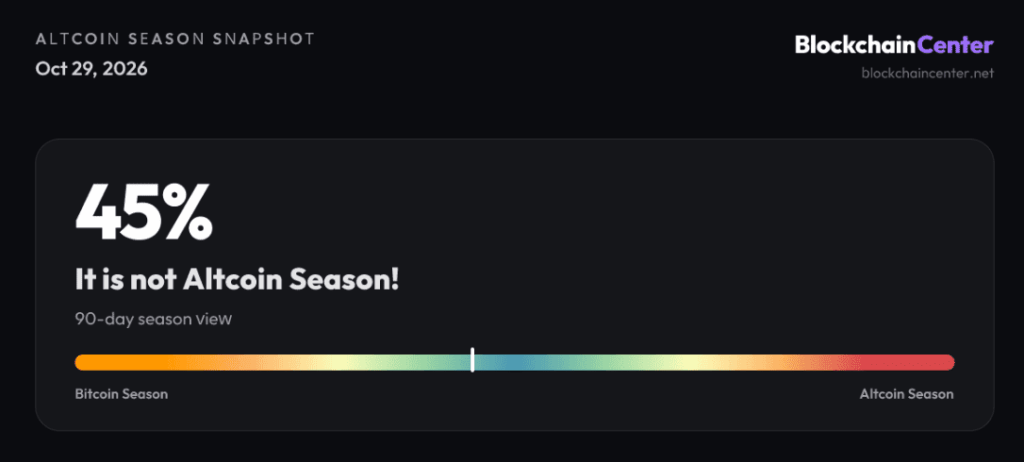
Source: BlockchainCenter Altcoin Season Index
How the Index Is Calculated — and Its Limits
BlockchainCenter compares 90-day returns of its top-50 list with Bitcoin, then reports what percent of those coins beat BTC. Stablecoins are usually left out. When rankings change, coins enter or leave the list — that alone can move the score.
The index does not say which coin is good to buy. It does not score code quality, security, or real usage. Use it only to see how many large coins beat Bitcoin, then check dominance, ETH/BTC, volume, and liquidity before you risk money.
Key Indicators That Confirm or Challenge the Index
Do not rely on the index alone. Check these numbers together.
BTC Dominance, Relative Strength, How Many Coins Beat Bitcoin, and Liquidity
Bitcoin dominance near 58.5% (CoinGecko, October 29, 2026) means most market value is still in Bitcoin. A real rotation usually needs dominance to fall for several weeks while more coins beat BTC — not one green day.
Also watch ETH/BTC and other large pairs: if they rise for weeks, more money may be moving past Bitcoin. Count how many top coins beat Bitcoin (that is what the index already summarizes). Check volume and order-book depth: thin markets can look strong and then fail on exit.
Stablecoin balances on exchanges can show spare cash waiting to buy — or money leaving risk. The Crypto Fear & Greed Index was 51 (Neutral) on the same day. That is a mood reading only; it does not time seasons. If dominance, volume, and ETH/BTC disagree with a high index reading, wait for clearer agreement.
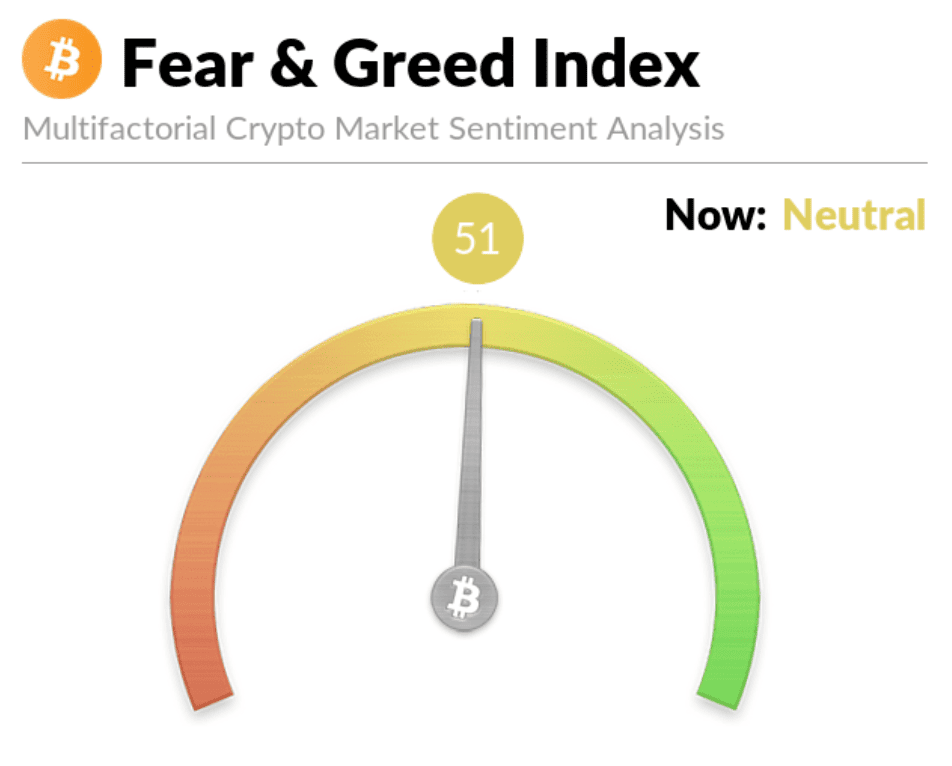
Source: Alternative.me Crypto Fear & Greed Index
Historical Altcoin Rally Patterns
Past cycles used different drivers. History helps you set expectations; it does not give the next start date.
Lessons from 2017–2018 and 2020–2021
In 2017–2018, many gains came from ICO launches and retail buying. In 2020–2021, DeFi, NFTs, new Layer-1 chains, and later meme coins led at different times. Not every coin rose together.
For 2026, expect the same pattern: some sectors move first (for example AI tokens, real-world asset projects, or DePIN), while other large coins stay flat. Even if the index rises toward 75, check each coin’s usage, liquidity, and unlock schedule before you buy.
Phases of Altcoin Season
Many traders split a season into three stages. Timing still varies by cycle.
| Phase | Core signal | Typical focus | Caution |
|---|---|---|---|
| Pre-season | BTC flat or correcting; few alts beat BTC | Large and mid-cap coins you already research | Low volume; false starts |
| Early season | A few sectors rise first | Coins in those sectors | Buying after a long run-up |
| Peak season | Many top-50 coins beat BTC; high social noise | Smaller caps and new launches | Hard exits; leverage losses |
Pre-Season: Accumulation and Stabilization
Bitcoin may move sideways. Many altcoins lag. Volume is often low. This is a time to research projects and list coins you understand — not a signal that “now is always the best buy.”
Early Season: Narrative-Led Breakouts
Money often hits a few themes first (AI, RWA, DePIN, and similar). Many top-ten coins can still lag. Check live sector leaders on your update date; yesterday’s leader can stall within days.
Peak Season: Broad Participation and Higher Risk
More coins rise. Social media gets louder. Leverage and new launches rise too. Plan position size and exits while markets are still liquid. Do not treat any fixed “X× gain in Y weeks” claim as a fact.
Altcoin Season vs. Bitcoin Season
These labels describe which side beat the other over the comparison window — not a rule that prices only go up.
| Bitcoin season | Altcoin season | |
|---|---|---|
| Relative performance | BTC beats most major alts | Most major alts beat BTC |
| Capital feel | Money stays in BTC (often via ETFs) | More buying across altcoins |
| Dominance (context) | Often high or rising | Often falling as more alts beat BTC |
| Transition clues | Alts lag BTC | Large alts strengthen; index moves toward 75 |
A coin can rise in USD and still lose to Bitcoin on a percentage basis. Watch for multi-week changes in dominance and in how many coins beat BTC — not one daily print.
When Is the Next Altcoin Season?
No one can name an exact start date. Compare today’s numbers with three simple cases.
Timing Signals and Scenarios
Bull case: Bitcoin is stable or rising, dominance falls for weeks, ETH/BTC and other large pairs stay strong, the index moves toward 75, and trading volume rises.
Base case: the index stays near the middle (like today’s 45) while only some sectors rise. Useful for a prepared watchlist — not for expecting every coin to pump.
Bear case: Bitcoin falls hard, dominance rises, few coins beat BTC, and money leaves into stablecoins. Altcoins usually fall with Bitcoin rather than “take over.”
As of October 29, 2026, index 45 plus Bitcoin dominance near 58.5% fits the base case more than confirmed altcoin season.
Next Altcoin Season Coins and Tokens: What to Watch
When the index rises, people search for “next altcoin season coins.” The leaders change every cycle. Use a checklist instead of a fixed tip list.
Next Altseason Coins to Buy? Use Criteria, Not Hype
There is no reliable advance list of winners. Higher upside usually means higher risk of liquidity gaps, smart-contract bugs, and deep drawdowns.
Checklist:
- Real users or on-chain activity you can verify
- Active development updates
- Clear token supply and unlock dates
- Enough market volume to buy and sell
- Audits or a long live track record where relevant
- Relative strength versus Bitcoin and versus peers in the same sector
Update the list when unlocks, hacks, or sector leaders change. This is research help — not personal investment advice.
How to Prepare for the Next Altcoin Season
Quiet markets are for preparation. Build the list and the tools now so you are not guessing during a fast move.
Building and Maintaining a Watchlist
Pick coins with liquid markets, clear token rules, and activity you can check (users, fees, developers). Note unlock dates and large holder concentration. Group by sector and risk so you can change one group without rewriting everything. Refresh after unlocks, incidents, or clear strength/weakness versus Bitcoin.
Trading Infrastructure and Using StealthEX
Use a hot wallet for active swaps and stronger offline storage for amounts you plan to hold. StealthEX is a non-custodial exchange: for a normal swap, coins move from your wallet to your other wallet. StealthEX does not keep a trading balance for you. Rates can be fixed or floating. No account is required for a standard exchange.
You can swap across chains when you need a different network. Flagged transactions may still ask for verification. Before you send, confirm network, address, rate type, and the live quote.
Risk Management During Altcoin Season
Size each position so one bad coin cannot wipe most of your capital. Hold only ideas you understand. Prefer liquid markets if you may need to sell quickly. Keep long-term holdings in wallets you control; check address and network every time.
Stop-losses help on venues that support them, but gaps and thin books can skip your price. Decide take-profit levels and keep some stablecoins for later buys. Match risk to your time horizon — there is no one allocation for everyone.
Frequently Asked Questions
What Is the Current Altcoin Season Index Value?
As of October 29, 2026, the Altcoin Season Index stands at 45/100, according to BlockchainCenter, placing the market in the neutral (mixed) zone rather than altcoin season. For the full breakdown of index values and classifications, see the “Current Value, Thresholds, and Source” section.
When Is Alt Season?
There is no fixed date. Stronger confirmation usually needs stable Bitcoin, falling dominance, stronger large-alt pairs, and the index moving toward 75.
Can Altcoin Season Happen While Bitcoin Is Falling?
Short gaps can appear, but a wide, lasting altcoin season is less likely in a sharp Bitcoin crash, when money usually leaves crypto overall.
When Will Altcoins Pump?
Rallies more often follow weeks of better relative strength, higher volume, and more coins beating Bitcoin — not a promised calendar day.
What Is BTC Season?
Bitcoin season is when Bitcoin beats most major altcoins over the comparison window. An altcoin can still rise in USD while lagging Bitcoin in percent terms.
Conclusion
On October 29, 2026, the Altcoin Season Index is 45. Check it with Bitcoin dominance, ETH/BTC, volume, and liquidity before you act. To swap coins you already hold, compare a wallet-to-wallet quote on StealthEX.
This article is informational only — not financial, legal, or tax advice. Crypto prices move fast. Index readings are not price forecasts. Check fees, liquidity, and local rules before any trade.
altcoin altcoin season altcoins Bitcoin what is altcoinRecent Articles on Cryptocurrency